This monthly overview from Sahel Watch brings together, from a monitoring vantage point, the significant developments in security, geopolitics and economics in West Africa over recent weeks. It complements our in-depth analyses without replacing them: each signal links to a dedicated explainer. It follows the July 2026 overview and the June 2026 overview. The aim: to offer exposed decision-makers a dated, sourced and neutral reading of regional risk.
Security: a threat that is becoming regional and settling in for the long term
Summer 2026 confirms an underlying trend: the central Sahel remains one of the world’s main hotspots of jihadist violence, according to data compiled by the Africa Center for Strategic Studies. Two rival movements shape the threat: JNIM, affiliated with al-Qaeda, and the Islamic State in the Sahel (ISGS). Their rivalry, which we detail in our analysis of the JNIM-ISGS rivalry in Mali, coexists with occasional tactical alliances.
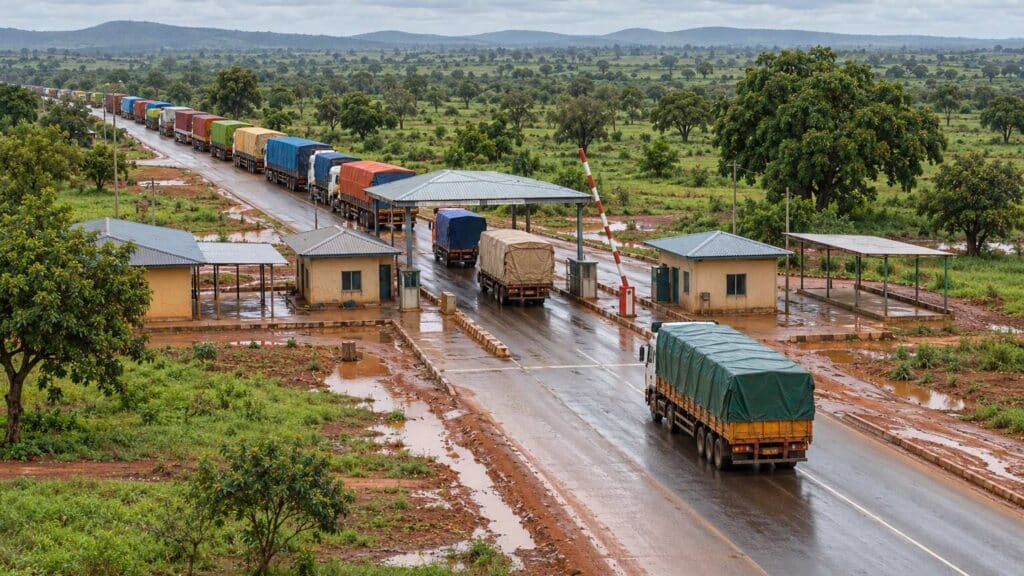
In Mali, the fuel blockade imposed by JNIM around Bamako since September 2025 remains, in mid-August 2026, the security development with the heaviest consequences. The International Crisis Group was already describing a capital “under heavy pressure” after two months of de facto economic siege, without a shot being fired in the city. The Malian authorities have publicised convoys reaching Bamako under escort — several hundred tanker trucks — but supply remains dependent on trade corridors that are regularly targeted, notably the vital Bamako-Kayes route towards Côte d’Ivoire, Senegal and Mauritania.
This pressure follows on from the wave of coordinated attacks of 4 July 2026, which struck Gao, Anéfis, Aguelhoc, Sévaré and Keniéroba almost simultaneously, from northern Mali to the outskirts of Bamako. The rise of armed drones accompanies this development: according to counts by specialist institutes, drone strikes attributed to JNIM reportedly rose from fewer than ten cases in 2024 to around eighty in 2025.
In Niger, the authorities continue to manage persistent pressure in the Tillabéri region. President Abdourahamane Tiani again referred to the attack of 18 June 2026 on Diori Hamani International Airport in Niamey, which he attributed to actors he says are backed by France — accusations that Paris rejects and that we place in context in our analysis of the break with France in Niger. The coastal countries, from Benin to Togo, remain exposed to the threat spilling over into their northern margins.
Geopolitics: a cautious diplomatic thaw between ECOWAS and the AES
The major diplomatic event of the period was the visit to Bamako, on 28 July 2026, of Senegalese President Bassirou Diomaye Faye. Presented by several regional media outlets as the first visit by a sitting ECOWAS chair to a country of the Alliance of Sahel States (AES) since the latter’s withdrawal took effect on 29 January 2025, it carries the weight of a signal. Received by General Assimi Goïta, Mr Faye — who took over the rotating chairmanship of ECOWAS in mid-July — expressed Senegal’s solidarity in the face of the attacks and raised the possibility of normalisation: free movement of people and goods, management of shared infrastructure, counter-terrorism cooperation.
This gesture is part of a sequence of “small steps”. ECOWAS has extended until December 2026 the mandate of its chief negotiator with the AES, and reiterated that the talks would take place within a collective framework. This is not a reversal — the three states’ exit from the regional bloc is a done deal, as we analyse in the implications of the withdrawal from ECOWAS — but a search for pragmatic coexistence, driven in particular by Senegal’s diplomatic role.
At the same time, the AES is pursuing its military institutionalisation. Following on from the legal status of the Unified Force approved in July, President Tiani indicated at the end of July that the troop target would be raised to 18,000 personnel, compared with a target of 15,000 mentioned in the spring. Tensions with neighbours remain high: after remarks by Nigerian President Bola Tinubu in late July attributing the rise in kidnappings and attacks in Nigeria to a security “collapse” among its Sahelian neighbours, Burkina Faso, Mali and Niger jointly expressed their “deep regret” in early August. The backdrop remains a reshaping of external influences, in which the weight of Russian influence remains central, in the wake of the break between Burkina Faso and France.
Economy: resilient growth against a backdrop of persistent dependencies
The contrast between security risk and macroeconomic dynamism remains the region’s signature. For 2026, the African Development Bank projects growth of around 4.6% for West Africa; WAEMU expects growth in the order of 6.1% for the Union, while the World Bank gives a more cautious estimate of around 4.3% for the sub-region. These figures, to be treated as projections rather than achieved results, place the area above the expected global average (around 3.1% according to the IMF).
Inflation remains broadly under control within WAEMU, at around 0.4% to 0.8% in spring 2026 according to BCEAO economic notes — a relatively stable price environment, even if logistical strains linked to insecurity weigh locally on the cost of living, particularly in Bamako. On sovereignty, the AES is pursuing its financial project — confederal investment bank, common customs duty, confederal passport — which we detail in our analysis of the financial sovereignty of the AES, with the prospect of a common currency remaining a medium-term horizon.
Resource nationalism is confirmed as a lever for revenue and political assertion. Our explainer on the nationalisation of gold mines in the Sahel remains relevant: renegotiation of mining codes, increased state shareholdings in projects and stand-offs with the majors continue to redraw the sharing of gold revenue, in a context where gold accounts for a decisive share of exports from both Burkina Faso and Mali.
What this means for exposed organisations
For security managers, NGOs and investors operating in the region, three lessons emerge from this month of August. First, risk must be considered on a regional scale rather than country by country: the threat moves along corridors and border areas, as shown by our map of security risks in West Africa. Second, logistical risk — fuel, supply, continuity of convoys — has become a business continuity issue in its own right, particularly for isolated mining and industrial sites. Finally, the nascent diplomatic thaw does not change operational exposure in the short term: evacuation plans, staff protection and employer obligations remain priorities, as our analysis of duty of care in the Sahel points out.
Anticipating these shifts in the threat requires continuous, dated and mapped monitoring. That is precisely Sahel Watch’s purpose: turning a fragmented flow of information into an actionable reading of risk.
Frequently asked questions
What was the most significant security development in the Sahel in summer 2026?
The fuel blockade imposed by JNIM around Bamako, in place since September 2025, remains the development with the heaviest consequences. It is economically suffocating the Malian capital and illustrates a siege strategy based on controlling supply corridors rather than seizing territory.
Does Bassirou Diomaye Faye’s visit to Bamako mark a return of the AES to ECOWAS?
No. The withdrawal of Mali, Burkina Faso and Niger from ECOWAS has been effective since 29 January 2025. The visit of 28 July 2026, the first by a sitting ECOWAS chair to an AES country since that withdrawal, reflects a desire for pragmatic coexistence and a resumption of dialogue, not reintegration.
Does the region remain economically attractive despite the insecurity?
Growth projections for 2026 remain strong (in the order of 4.3% to 6.1% depending on the institution and the scope used) and inflation remains under control in WAEMU. Macroeconomic dynamism nonetheless coexists with strong logistical dependencies and a security risk that weighs on costs and the continuity of operations.
How often does Sahel Watch publish this overview?
The overview is a monthly publication that brings together key developments in regional security, geopolitics and economics, with systematic links to our in-depth analyses for further reading on each topic.