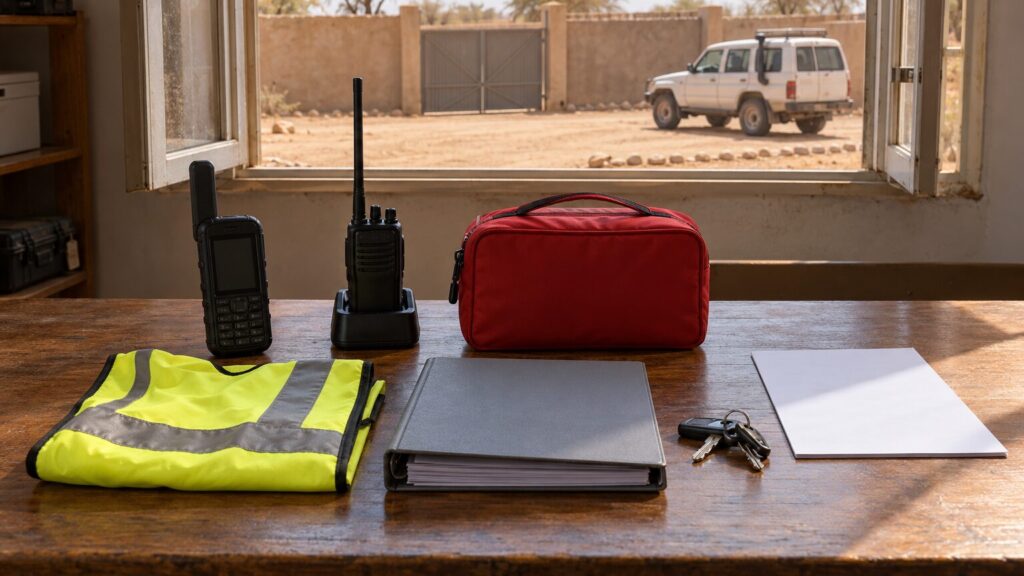
Protecting your teams is not an option: it is an obligation. In a Sahel where a locality can tip over within a few hours, any organisation that deploys staff — mining operator, construction or energy company, humanitarian NGO, consultancy, donor — is responsible for the safety of its employees. This is the duty of care: all the measures an employer must take to prevent the risks to which it exposes its teams, including abroad and in conflict zones.
2026 has made this obligation markedly heavier. The large coordinated FLA–JNIM offensive in the spring and summer, the blockade of Bamako, the spread of drones and the increase in kidnappings have degraded an already tense environment — while the severance of diplomatic relations between Burkina Faso and France reduces, for many organisations, the consular and military safety nets they relied on. This guide explains what duty of care covers in West Africa, why it is becoming more demanding, and how to translate it into a practical set-up.
Duty of care: what are we talking about?
Duty of care refers to an organisation’s obligation to take reasonable measures to protect the health, safety and well-being of the people it employs or is responsible for. It is neither a moral stance nor a mere HR argument: it is a legal and operational requirement, measured by concrete actions — before, during and after a deployment.
A safety obligation that does not stop at borders
Under French law — to which many companies and NGOs operating in the Sahel are subject — article L.4121-1 of the Labour Code requires the employer to “take the measures necessary to ensure the safety and protect the physical and mental health of workers”. This safety obligation applies in full when the employee is sent abroad, and it is all the stronger when the host country is exposed to a risk of conflict. It covers information and training beforehand, crisis management procedures, appropriate health cover and, if the situation deteriorates, emergency measures that may go as far as repatriating the employee and their family. The legal systems of the region (national labour codes, the OHADA area) and common law for English-speaking groups enshrine equivalent duties: whatever the jurisdiction, exposing an employee without protective arrangements engages the organisation’s liability.
Companies and NGOs: two frameworks, one requirement
For companies, the international benchmark is now the ISO 31030:2021 standard (“Travel risk management — Guidance for organizations”), which structures the management of travel-related risk: policy, assessment of threats and destinations, allocation of responsibilities, communication, incident response. It applies to any organisation, whatever its size or sector. On the humanitarian side, the GISF (Global Interagency Security Forum) is the reference, with its security risk management guides, including resources dedicated to the Sahel. Both worlds converge on the same foundation: anticipating the threat, preventing exposure, knowing how to respond — and being able to prove it.
Why the duty of care is becoming more demanding in the Sahel in 2026
The level of diligence expected of an employer is proportionate to the actual risk. And that risk has increased. Armed groups systematically use sieges, kidnappings, improvised explosive devices, mines and drones as deliberate tactics; jihadist territorial control and the frequency of attacks are increasing in central Mali, northern Burkina Faso and the tri-border area, with spillover towards the coastal states. The United Nations itself warns of a threat that is “changing its face”. In this context, an organisation can less and less claim unpredictability: the signals exist, they are documented, and inaction becomes all the harder to justify. Added to this is a new factor: the withdrawal of foreign military partners and diplomatic ruptures reduce the support capabilities — intelligence, evacuation, consular relays — that many actors took for granted. The duty of care therefore rests more heavily on the shoulders of each organisation.
The four pillars of a duty of care set-up
A credible duty of care cannot simply be declared: it is organised around four complementary functions.
1. Assess the risk — by country, by area, by route
Everything starts with an honest and dated risk assessment, at the right level of detail: not “Mali” as a whole, but a particular region, road or time slot. This is the purpose of an up-to-date map of security risks, able to distinguish a capital under strain from a rural area under armed control. This assessment must be continuously revised on the basis of signals of local security deterioration — an incident on a road, school closures, population displacement — which often precede an attack.
2. Prevent — inform, train, secure movements
Prevention is the heart of the set-up. It involves informing and training teams before departure, clear movement rules (approval of movements, varied routes and times, redundant communications) and heightened vigilance at the most exposed moments. In the Sahel, vulnerability No. 1 is not the office: it is the road, as shown by repeated attacks on regional trade corridors and on convoys, including escorted ones — an issue detailed for industry in our guide to mining site security. Prevention also covers the protection of expatriate and national workers and reducing the risk of staff kidnapping, two inseparable components of the duty of care.
3. Respond — crisis unit, thresholds, evacuation
No amount of prevention eliminates residual risk: the response must therefore be prepared. This requires a crisis unit with a clear mandate, decision thresholds defined in advance — from strengthening measures to suspending activity — and, at the end of the chain, a realistic evacuation plan, tested rather than left on paper. In an environment where external support is becoming scarce, the ability to extract one’s staff by one’s own means becomes a decisive marker of seriousness.
4. Document — record due diligence
The fourth pillar is the most neglected: traceability. Recording risk assessments, decisions taken, training provided and measures deployed is in no way a bureaucratic exercise. It is what makes it possible, in the event of an incident, to demonstrate that the organisation has met its responsibilities — and what, beforehand, forces it to close blind spots. An undocumented set-up is, legally as well as operationally, a fragile one.
NGOs and national staff: the blind spot of duty of care
The duty of care is often designed with expatriates in mind. Yet in the Sahel, it is overwhelmingly national staff, drivers, field workers and local partners who pay the heaviest price: more exposed, less covered, sometimes absent from security plans. The GISF stresses this point and offers tools so that security is designed according to each person’s location, role and profile, and not according to status alone. For NGOs, this means clearly sharing responsibility for risk with local partners rather than transferring it to them — an issue all the more pressing as humanitarian action becomes “localised”. Extending the duty of care to the entire human chain, subcontractors included, is not a favour: it is the condition for a coherent set-up.
Anticipate rather than endure: monitoring, the foundation of the duty of care
The four pillars share a common prerequisite: seeing things coming. You can only protect well against a threat you anticipate. Assessing risk, triggering the right thresholds, deciding on reinforcement or evacuation at the right time: everything rests on reliable, dated and mapped security information. This is precisely what structured monitoring provides, aggregating incidents, tracking their development zone by zone and presenting them as decision-making indicators — enough to settle the fundamental question, investing or staying despite insecurity, in advance rather than by guesswork. That is the purpose of Sahel Watch’s monitoring platform, designed for security managers, NGOs and decision-makers present in West Africa, of which our monthly security overview gives a glimpse.
FAQ
What is duty of care?
It is an organisation’s obligation to take reasonable measures to protect the safety and health of the people it employs or deploys, including abroad. It translates into concrete actions: risk assessment, information and training, prevention and crisis management arrangements, and evacuation capability.
Is the employer responsible for the safety of an employee in a conflict zone?
Yes. The safety obligation — under French law, article L.4121-1 of the Labour Code, with equivalents in other legal systems — does not stop at borders and becomes stronger when the host country is at risk. It may extend to an obligation to urgently repatriate the employee and their family in the event of a crisis.
What is the ISO 31030 standard?
ISO 31030:2021 is an international standard for travel risk management. It helps organisations — companies and NGOs alike — build a coherent programme: policy, assessment of threats and destinations, responsibilities, communication and incident response. It has become a benchmark for objectively assessing duty of care.
How does an NGO fulfil its duty of care in the Sahel?
By assessing risk at local level, training and informing its teams, giving priority to protecting national staff and local partners (the most exposed), preparing a crisis unit and evacuation, and documenting all of this. GISF tools offer a practical framework suited to the Sahelian context.
Sources and references
- ISO — ISO 31030:2021, Travel risk management — Guidance for organizations.
- GISF (Global Interagency Security Forum) — “Security in practice”: a risk management toolkit for NGOs.
- Fidal — “Foreign elements and international conflicts: the employer’s safety obligations”.
- Africa Center for Strategic Studies — “Attacks in Mali Underscore Worsening Security Trajectory” (2026).