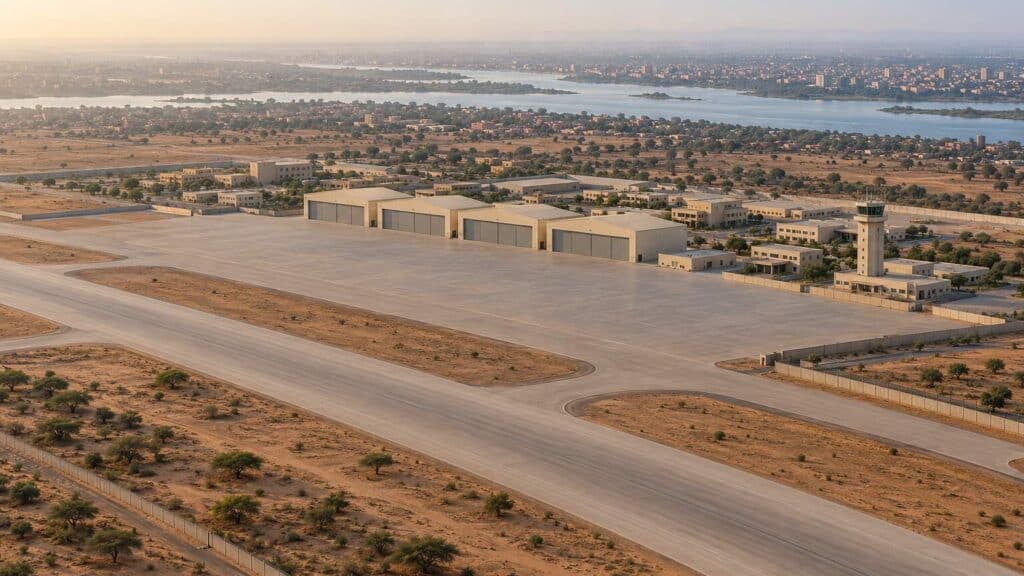
Since the collapse of the G5 Sahel, one question has been troubling the security managers, NGOs and analysts who follow Mali, Burkina Faso and Niger: what military architecture will replace the arrangements inherited from the Barkhane decade? The answer now has a name — the Unified Force of the Alliance of Sahel States (FU-AES) — and a figure that keeps rising. Launched at the end of 2025, this joint army of the three countries of the tri-border area has established itself, within a few months, as the centrepiece of the new Sahelian security architecture. Here is what it is, what it changes and what it does not resolve.
What is the AES Unified Force?
The FU-AES is the joint armed wing of the confederation born of the withdrawal of Mali, Burkina Faso and Niger from ECOWAS. Launched in December 2025 and based in Niamey, it aims to pool the capabilities of the three armies and to coordinate counter-terrorism on both sides of borders that armed groups ignore. According to the Institute for Security Studies (ISS), it is the third attempt at a common security mechanism in the central Sahel, after the 2017 Multinational Joint Force and the G5 Sahel Joint Force, which became inoperative after the departure of foreign forces and the withdrawal of contingents between 2022 and 2023.
The AES, which became a confederation on 6 July 2024, has made it one of the symbols of its asserted sovereignty — alongside its common biometric passport, its investment bank and its currency project. On the ground, the stakes are concrete: after the end of MINUSMA and the departure of Barkhane, the three states must provide on their own a security coverage that external partners no longer take on.
From 5,000 to 15,000 troops: the 2026 build-up
The trajectory of troop numbers sums up the ambition. Announced at 5,000 troops in early 2025, the force was increased to 6,000 at the end of 2025, with the Nigerien president justifying this reinforcement by “high-technology” threats, according to the Anadolu Agency. Then, on 16 and 17 April 2026, the chiefs of staff of the three countries approved a much sharper jump: a target of 15,000 soldiers, reported in particular by Africa Defense Forum. In little more than a year, the joint force will thus have tripled its troop target.
This build-up is not only about numbers. FU-AES units are designed to operate freely across the entire territory of the three countries, whereas G5 Sahel battalions were confined to a right of pursuit limited to around a hundred kilometres on either side of borders. It is a doctrinal as well as an organisational break.
How does the AES force differ from the G5 Sahel?
The comparison with the G5 Sahel is not merely historical: it shows why AES leaders believe they will succeed where the previous arrangement failed. In five years, the G5 Sahel Joint Force conducted only around twenty-five operations and never managed to halt the spread of the threat, for lack of air assets, intelligence and sustainable funding, the ISS recalls. Three structural differences are highlighted.
Integrated command and freedom of movement
According to the ISS, the FU-AES command would have full operational authority: it can deploy and employ its units without prior approval from national general staffs. This integration — and cross-border freedom of movement — removes one of the obstacles that had paralysed the G5 Sahel, whose operations depended on constant national arbitration. It remains to turn this theoretical asset into genuinely coordinated operations.
Sovereign funding… but uncertain
Whereas the G5 Sahel suffered from chronic underfunding — an annual operational budget estimated at €423 million, far above the states’ contributions — and a heavy dependence on external partners, the AES claims national funding. On 28 March 2025, the three countries introduced a 0.5% levy on imports to finance their confederal institutions, including the force; they also mobilise dedicated national funds (Patriotic Support Fund in Burkina Faso, Solidarity Fund in Niger, an equivalent fund in Mali). The breakdown of contributions has not been made public, and the sustainability of this model — partly backed by mining revenue — remains an open question.
Diversified partners rather than a single sponsor
To avoid reproducing dependence on France, the AES is diversifying its suppliers: equipment and weapons come from Russia, Turkey, Iran and China. Russia, through the Africa Corps, remains the preferred security partner, but in variable forms according to the ISS: participation in combat in Mali, training only in Burkina Faso and Niger. This diversification reduces dependence on a single actor — without eliminating it.
On the ground: first operations and joint strikes
The force is not just an organisational chart. The AES armies have already demonstrated real coordination during the tripartite operation Yéréko 2 (February-March 2025) in Liptako-Gourma, presented as directed against ISGS. Above all, in May 2026 the Alliance confirmed joint air strikes in Mali, following attacks attributed to jihadists linked to Al-Qaeda and to Tuareg separatist groups. The growing use of air power — and the widespread use of drones — marks a shift compared with the G5 Sahel era, when the lack of air assets was a major weakness.
These engagements take place against a backdrop of a threat that remains intense, driven by the rivalry between JNIM and ISGS and by groups capable of striking towns as well as roads — as illustrated by the fuel blockade imposed on Bamako.
The limits weighing on effectiveness
The ambition runs up against constraints that neither troop numbers nor statements are enough to remove. Analysts point to several converging weaknesses:
- The air and intelligence deficit: despite the recent strikes, the lack of a common air fleet and an integrated intelligence system remains a handicap — precisely the gaps that had undermined the G5 Sahel.
- Sustainable funding not guaranteed: dependence on mining revenue and non-Western partners weakens the long-term viability of the model.
- Isolation from ECOWAS: sanctions, diplomatic tensions and institutional rupture complicate cooperation with neighbours that are nonetheless exposed to the same networks.
- The mobility of armed groups: adaptable and cross-border, they exploit the blind spots between states.
- The risk of internal rivalries in running a command that is genuinely shared by three armies.
The ISS stresses an often overlooked point: an effective regional force cannot treat the Sahel as an isolated space. Its success will depend on its ability to coordinate with national forces — including units that do not fall under its command — and with the Gulf of Guinea neighbours (Nigeria, Benin, Côte d’Ivoire, Togo, Ghana, Guinea, Senegal), many of which face the same threat. The question remains open as to whether national armies can hold out by relying on this new joint echelon.
What the unified force changes for economic and humanitarian actors
For a security manager, an NGO or an investor, the FU-AES is not an abstract subject: it is redrawing the security architecture within which sites, corridors and teams operate. Three implications deserve attention. First, the geography of operations is changing: mobile units authorised to cross borders can quickly alter the security level of a route or an area. Second, the interplay of partners — notably the presence of the Africa Corps — weighs on the local environment and on how populations perceive it, a reputational risk parameter to factor in at a time when the interplay of the major powers is shaping the region. Finally, the reliability of information becomes decisive: between triumphant statements and contradictory sources, only rigorous and dated cross-checking makes it possible to assess the real capacity of the armies and of the joint force.
This is precisely the purpose of structured monitoring: tracking, zone by zone, the real evolution of the security architecture and of the threat in order to make decisions with a cool head. The Sahel Watch monitoring platform aggregates and maps these signals for security managers and operators present in West Africa.
FAQ
What is the AES Unified Force?
It is the joint army of the Alliance of Sahel States (Mali, Burkina Faso, Niger), launched in December 2025 and based in Niamey. It pools the capabilities of the three countries to fight jihadist groups and coordinate cross-border operations.
How many soldiers does the AES force have?
Announced at 5,000 troops in early 2025, it rose to 6,000 at the end of 2025. On 16 and 17 April 2026, the chiefs of staff of the three countries approved a target of 15,000 soldiers.
How does it differ from the G5 Sahel?
The FU-AES claims an integrated command, freedom of movement across the three territories and national funding, whereas the G5 Sahel suffered from a compartmentalised command, chronic underfunding and heavy dependence on France and Barkhane.
Who funds the AES Unified Force?
The three states, through dedicated national funds and a 0.5% levy on imports introduced on 28 March 2025. The breakdown of contributions has not been made public and the sustainability of the model remains debated.
Is the AES force effective against the jihadists?
It has conducted joint operations (Yéréko 2 in 2025) and air strikes in 2026, but its lasting effectiveness will depend on air and intelligence assets that are still limited, on sustainable funding and on coordination with national armies and neighbouring countries.
Sources and references
- Institute for Security Studies (ISS) — “Will the AES force do better than the G5 Sahel’s?” (4 March 2026).
- Africanews — “Alliance of Sahel States confirms joint airstrikes in Mali” (1 May 2026).
- Anadolu Agency — the AES unified force grows from 5,000 to 6,000 troops.
- Africa Defense Forum — “AES Seeks to Strengthen CT Efforts Through Unified Force” (April 2026).