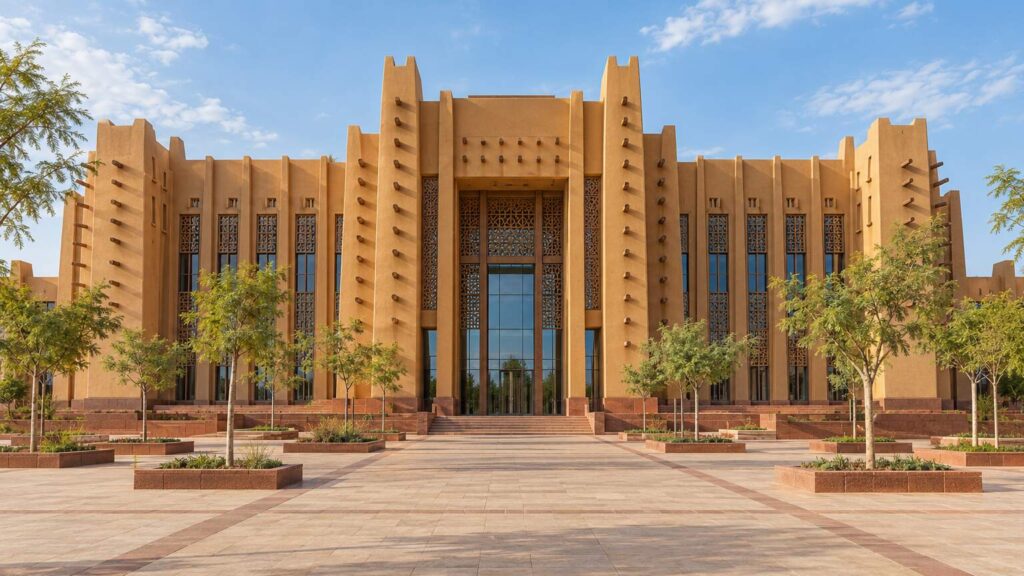
After common defence, the Alliance of Sahel States (AES) is methodically building its financial sovereignty: a confederal bank endowed with CFA 500 billion, a common customs duty, a shared passport and identity card, and the more distant project of a common currency. In 2026, the project is moving from announcement to implementation. For companies, NGOs and institutions present in Mali, Burkina Faso and Niger, this realignment is not merely a political symbol: it changes import taxation, access to banking, staff mobility and the regulatory environment. A dated and sourced analysis.
1. From military alliance to economic sovereignty
Created on 16 September 2023 as a mutual defence pact between Mali, Burkina Faso and Niger, the AES became a confederation in summer 2024, before formalising its withdrawal from the Economic Community of West African States (ECOWAS), effective in early 2025. We have detailed the implications of this withdrawal from ECOWAS and the reasons why ECOWAS is contested by the three capitals. After the security dimension, embodied by the AES Unified Force, it is now the economic and monetary field that has become the arena for the claim to sovereignty.
The logic is explicit: reduce dependence on institutions inherited from the regional order (ECOWAS, the CFA franc, Western donors) and acquire instruments of their own. This trajectory is part of a broader geopolitical realignment in which the influence of the major powers — Russia first and foremost — weighs increasingly on the three states’ choices.
2. The confederal bank (BCID-AES): the Alliance’s financial arm
The centrepiece of the system, the Confederal Investment and Development Bank of the AES (BCID-AES), was inaugurated on 23 December 2025 in Bamako, in the presence of the three heads of state. Announced as early as September 2024, it has initial capital of CFA 500 billion (around $890 million) and is chaired by Professor Balibié Serge Auguste Bayala, appointed in early 2026. On 8 June 2026, its governors laid the operational groundwork: budget approval, recruitment policy and fundraising strategy.
Its mission: to finance regional infrastructure, energy, agriculture, transport and industrialisation, all sectors deemed strategic for the bloc’s autonomy. The ambition is to create a financing channel free from the traditional regional institutions — a bet whose success will depend on the bank’s ability to raise funds and convert announced capital into real projects. This question of financing ties in with that of external alignments, as Russian influence also extends into the economic and technological sphere.
3. The 0.5% common customs duty: the first fiscal building block
Less spectacular but already in force, the common customs duty is the Confederation’s first own resource. At the end of March 2025, the three states introduced a 0.5% levy on imports from countries that are not members of the Alliance, intended to fund its budgetary autonomy. In practice, goods from neighbouring ECOWAS countries — now treated as third countries — bear this levy, which makes some supply chains more expensive.
This new taxation comes on top of an already strained logistical reality: the security of regional trade corridors determines the cost and fluidity of imports, and the fuel blockade around Bamako showed how vulnerable a landlocked economy remains to pressure on its routes. For importers, the combination of levy and corridor risk is becoming a cost parameter in its own right.
4. Confederal passport and identity card: documentary sovereignty
AES sovereignty also has a very concrete sovereign-prerogative dimension. The common passport has been in circulation since 29 January 2025, and enrolment for the confederal biometric identity card began in Niger on 27 March 2026. These documents aim to facilitate the movement of nationals of the three countries and to give substance to a confederal citizenship.
For organisations, these developments directly affect the mobility of national staff and document management: coexistence of AES and ECOWAS documents, harmonisation of border checks, adjustment of travel procedures. All parameters to factor in against a backdrop of diplomatic realignments that are also changing the framework for visas and administrative counterparts.
5. The common currency, the “sahel”: a long-term ambition
This is the most emblematic component — and the most distant. The AES has set out the ambition of an economic and monetary union with a currency named the “sahel”, which would be backed by the natural resources of the three countries. For its promoters, starting with the Nigerien authorities, leaving the CFA franc is presented as “an exit step” from the dependence inherited from the colonial period.
In practice, the project is “simmering on a low heat”. In 2026, the year is about operationalising existing tools — bank, customs, documents — rather than an imminent monetary break: the common currency remains a medium-term prospect whose credibility is debated among economists. For economic actors, uncertainty over the monetary horizon — retention of the CFA franc in the short term, a possible transition in the medium term — is in itself a risk factor to monitor.
6. What AES financial sovereignty changes for exposed organisations
For a company, an NGO or an investor, this realignment sends several operational signals. First, an additional fiscal and customs cost: the 0.5% levy and the growing divergence of trade rules from ECOWAS make it necessary to recalculate import costs and map the origin of goods. Second, monetary and banking uncertainty: between the retention of the CFA franc, the rise of the BCID-AES and the plan for a currency of their own, cash-flow planning, contractual clauses and access to financing must factor in a scenario of change. Finally, a documentary and regulatory dimension: staff mobility, compliance, and monitoring of regulatory frameworks that are drifting away from the ECOWAS area.
Conversely, the BCID-AES may also open up project financing opportunities — energy, transport, mining — in a region where the security of mining sites and infrastructure remains a top-tier issue. The fine line for organisations is to read political, economic and security risk simultaneously — exactly the cross-cutting reading offered by our monthly overview and continuously updated by Sahel Watch monitoring.
FAQ — AES financial sovereignty
What is the BCID-AES?
The Confederal Investment and Development Bank of the Alliance of Sahel States is the joint financial institution of Mali, Burkina Faso and Niger. Inaugurated on 23 December 2025 in Bamako with announced initial capital of CFA 500 billion, it is intended to finance the Confederation’s infrastructure, energy, agriculture, transport and industrialisation.
Does the AES already have its own currency?
No. The plan for a common currency named the “sahel”, backed by natural resources, remains a medium-term prospect. In 2026, the priority is operationalising existing tools — the confederal bank, the common customs duty, identity documents — rather than an immediate exit from the CFA franc.
What is the AES common customs duty?
Introduced at the end of March 2025, it is a 0.5% levy on imports from countries that are not members of the Alliance. It funds the Confederation’s budgetary autonomy and makes some imports more expensive, including from neighbouring ECOWAS countries now regarded as third countries.
What does AES financial sovereignty change for an organisation?
It introduces new costs (customs duty), monetary and banking uncertainty, and documentary adjustments for staff mobility. It may also open up project financing through the BCID-AES. All these developments call for cross-cutting monitoring of political, economic and security risks.
In brief
In 2026, the AES is moving its financial sovereignty from declaration to implementation: an operational confederal bank, an effective common customs duty, shared identity documents, and a monetary project that is still distant. For exposed organisations, the issue is not ideological but operational — costs, cash flow, mobility, compliance. To follow this shift week by week, see our July 2026 overview; to anticipate its effects zone by zone, Sahel Watch monitoring cross-references security, geopolitics and economics to support decision-making.
Sources: Wikipedia — Alliance of Sahel States (timeline, 0.5% customs duty, passport, “sahel” currency); Africa24 (BCID-AES capital); Financial Afrik (BCID-AES presidency); Africa24 Monde (common currency project); regional press reports from mid-2026. Some figures, from official sources, are cited with caution.