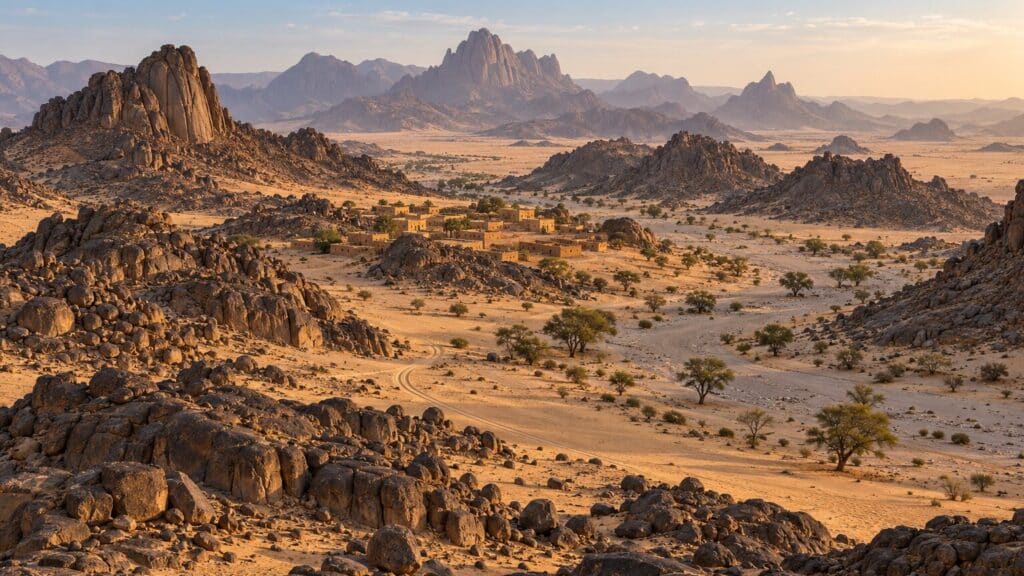
In 2026, the Azawad Liberation Front (FLA) became one of the armed actors with the greatest weight on the map of northern Mali. It took Kidal on 25 April, held it for more than five months, then left it without a fight on 6 October. In the meantime, it fought alongside JNIM, released dozens of Malian soldiers and fuelled a regional diplomatic crisis. This profile reviews its origins, leaders, objectives and alliances, then what its presence changes for organisations operating in the north of the country.
What is the Azawad Liberation Front?
The FLA is a predominantly Tuareg armed coalition, formed on 30 November 2024 through the merger of the main rebel movements of northern Mali. It claims “the total liberation of Azawad”, the name given by independence movements to the regions of Kidal, Timbuktu, Gao and Menaka, and the creation of an “Azawad authority”.
The FLA is not a jihadist group. Its project is territorial and political, neither religious nor transnational. This is what distinguishes it from JNIM, affiliated with al-Qaeda, and from the Islamic State in the Sahel, which we profiled in our piece on ISGS and its rise in 2026. Confusing it with them leads to misreadings of risk, as with the rebellions of northern Niger.
Where the FLA comes from: from 2012 to the 2024 merger
The FLA is the heir to a long line of Tuareg rebellions (1963, 1990, 2006, 2012). The most recent before it, in 2012, saw the National Movement for the Liberation of Azawad (MNLA) proclaim the independence of Azawad on 6 April 2012, before being driven out of the towns by jihadist groups, then by the French intervention of 2013.
The rebel movements, united in the Coordination of Azawad Movements (CMA), signed the Algiers agreement in 2015, which established a ceasefire and decentralisation. The agreement unravelled after the departure of MINUSMA, whose withdrawal effects we have analysed. The Malian army and the Wagner group retook Kidal on 14 November 2023; Bamako renounced the Algiers agreement in January 2024.
The military turning point came at Tinzaouatène, near the Algerian border, from 25 to 27 July 2024. The rebels, then grouped in the Permanent Strategic Framework (CSP-DPA), said they had killed 84 Wagner members and 47 Malian soldiers. The toll has not been independently verified, but these are the heaviest known Wagner losses in Mali.
From 26 to 30 November 2024, around 180 CSP-DPA cadres met and announced the dissolution of the framework in favour of a single movement: the FLA. It merges the MNLA, the High Council for the Unity of Azawad (HCUA) and dissident branches of the Arab Movement of Azawad (MAA) and the Imghad Tuareg Self-Defence Group and Allies (GATIA). The following day, 1 December, a drone strike near Tinzaouatène killed seven or eight of the movement’s cadres, including Fahad Ag Almahmoud.
Who leads the FLA and what does it demand?
Several historical figures from previous rebellions structure the movement. Bilal Ag Acherif, former secretary-general of the MNLA, is presented by several sources as its president. Alghabass Ag Intalla, former leader of the HCUA and from the family of the traditional chiefs of the Ifoghas of Kidal, is one of its main military and political figures. Public communication goes through spokesperson Mohamed Elmaouloud Ramadane; another official, Attaye Ag Mohamed, speaks regularly on questions of alliance.
The founding text speaks of self-determination and independence. In practice, statements in 2026 mainly targeted the fall of the government in Bamako and the departure of Russian forces: on 29 April 2026, an FLA spokesperson told AFP that the movement wanted to take Gao, Timbuktu and Menaka, while stating that it had “no particular problem with Russia”.
2026: from the capture of Kidal to the October withdrawal
On 25 April 2026, the FLA and JNIM launched coordinated offensives on several fronts, which we analysed in our article on the major FLA–JNIM offensive. The FLA took Kidal; the Russian and Malian garrison left the town the following day as part of a negotiated withdrawal, according to several accounts with Algerian mediation.
| Date | Location | Event |
|---|---|---|
| 25-26 April 2026 | Kidal | Town taken by the FLA, negotiated withdrawal of the garrison |
| 1 May 2026 | Tessalit | Military camp taken by the FLA and JNIM after the withdrawal of Malian and Russian forces |
| 4-5 July 2026 | Anéfis, Gao | New wave of coordinated attacks, fighting in Anéfis |
| 13 August 2026 | — | Release of 82 Malian prisoners, presented as “strictly humanitarian” |
| 4-5 October 2026 | Kidal, Tinzaouatène | Air strikes by the army |
| 6 October 2026 | Kidal | FLA “strategic withdrawal”, army and Africa Corps enter without a fight |
Source: Sahel Watch compilation based on AFP, RFI, Afrique Confidentielle and statements by the parties, as of 31 October 2026. Claimed tolls are not verified.
On 6 October, a convoy of around 120 vehicles that had left Anéfis entered Kidal. It carried Malian soldiers, Africa Corps members and MSA and GATIA militiamen aligned with Bamako. The FLA explained its departure by the strikes of 4 and 5 October and the risks to civilians remaining in the town. The town is largely empty. According to RFI, the movement still held Tessalit and Tinzaouatène in mid-October; military sources quoted by the press name these two localities as the army’s next objectives.
The significance of this recapture is debated. Beverly Ochieng (Control Risks) sees it as a symbolic rather than decisive gain; Jean-Hervé Jézéquel (International Crisis Group) considers that it does not change the balance of power. The FLA says it has preserved its fighters, and holding Kidal requires resupplying the town over hundreds of kilometres of track from Gao.
FLA and JNIM: a tactical alliance, not a merger
Coordination between the two movements has been confirmed by Attaye Ag Mohamed. According to press reports, the FLA reportedly agreed to apply a softened form of sharia in the areas it controls to seal this understanding. The two actors share an adversary, the Malian army and its Russian partners, but not a project: the FLA wants a territory, JNIM a religious order across the Sahel.
Watch point
In an analysis dated 3 September 2026, Hassane Koné (Institute for Security Studies) describes this partnership as “fragile”. JNIM has not commented on the withdrawal from Kidal. A rupture between the two movements would redraw the risk map in the north, but not necessarily in the direction of de-escalation.
To understand the other actor in this equation, see also our analysis of the rivalry between JNIM and ISGS in Mali and that of the Bamako blockade, which shows the other face of JNIM’s strategy.
External support: what is alleged, what is established
Bamako regularly accuses Algeria of supporting the FLA and other armed groups, Mauritania of offering it refuge, and France of facilitating meetings of its leaders in Europe. Africa Corps and Russian diplomacy have referred to “Ukrainian mercenaries” and the use of surface-to-air missiles of Western origin. None of these accusations has been publicly substantiated with verifiable evidence to date.
What is established relates more to geography: northern Mali borders Algeria, which was long the mediator of the peace agreements, and Saharan tracks remain supply routes, as shown in our article on the origin of armed groups’ weapons. At the end of October, the Tinzaouatène and Timiaouine border posts were temporarily closed, according to MaliJet quoted by Mondafrique, against a backdrop of Algerian operations against illegal gold mining in the south of the country. On the game of powers, see how major powers influence the Sahel and the real weight of Russian influence.
What this changes for organisations present in northern Mali
De facto authorities that change quickly. Kidal has changed hands twice in three years, Tessalit and Anéfis several times in 2026. An access agreement, an authorisation or a local contact can lose its value overnight. The mapping of actors must be revised with every shift in the front line, as proposed in our security risk assessment method.
Exposed logistics routes. The Gao–Anéfis–Kidal track is both the army’s supply artery and a target. Civilian convoys using it share this risk, including that of air strikes. The procedures described in our guide on road convoy security fully apply.
A displaced population and constrained humanitarian access. At the end of August 2026, UNHCR counted 414,524 internally displaced persons and 338,369 Malian refugees abroad. NGOs working in the Kidal region must negotiate their access with several authorities at once and manage the risk of staff kidnapping.
What we do not yet know
There is no reliable public estimate of the FLA’s numbers. The exact position of its fighters after the withdrawal from Kidal, the real extent of its control over Tessalit and Tinzaouatène and the state of its understanding with JNIM have not been independently established. Most of the tolls cited in this profile come from the belligerents. Sahel Watch will follow these points in its monthly overviews and on its security risk map.
Frequently asked questions
Is the FLA a terrorist group?
The FLA is a separatist armed rebellion, not a jihadist group. The Malian authorities regularly describe its fighters as “terrorists” in their communication, but it is not affiliated with al-Qaeda or the Islamic State, and its project is territorial.
What is the difference between the FLA, the MNLA and the CMA?
The MNLA is the 2012 independence movement. The CMA and then the CSP-DPA were coordination bodies for several movements. The FLA, created on 30 November 2024, merges them into a single organisation.
Does the FLA still control Kidal?
No. The FLA left Kidal on 6 October 2026 and the Malian army entered with Africa Corps. According to RFI, it still held Tessalit and Tinzaouatène in mid-October.
Is the FLA allied with JNIM?
The two movements have coordinated their offensives since April 2026, but their objectives diverge. Analysts describe a tactical and fragile alliance, not a merger.
Sources
- Afrique Confidentielle, “Mali: in Kidal, the army and Africa Corps retake an empty town”, 8 October 2026
- Mondafrique, “Speculation about Mali-Algeria border cooperation”, 23 October 2026
- PA-X, Pact of honour for the unity of the people of Azawad, 30 November 2024
- Le360, Tinzaouatène fighting, July 2024
- Jeune Afrique, recapture of Kidal by the Malian army, October 2026
Operating in this area? See the incidents on your routes in 20 minutes.