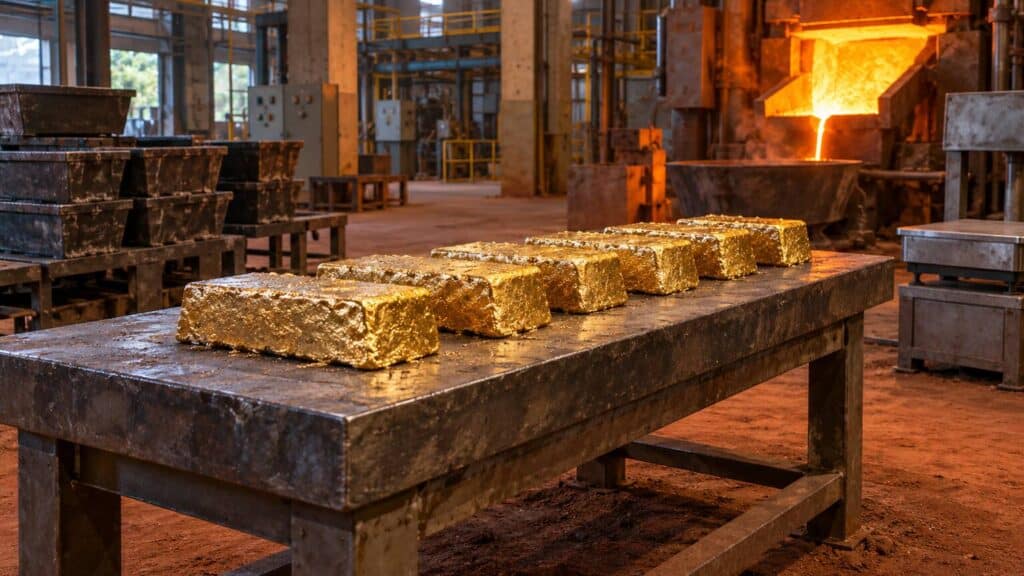
In West Africa, gold has become the fuel of both states and their adversaries. Mali, Burkina Faso and Niger are among the fastest-growing producers on the continent, and their transitional authorities have turned the yellow metal into a lever of sovereignty: new mining codes, increased equity stakes, nationalisations, standoffs with Western majors and an opening to the Russian partner. At the same time, a massive share of production escapes the state and feeds smuggling and armed groups. In 2026, this twofold battle for gold — between proclaimed sovereignty and war economy — is redrawing the risk for anyone who invests, operates or sources in the region.
Gold, the economic backbone (and Achilles’ heel) of the Sahel
To understand what is at stake, one must measure the weight of the sector. Mali ranks among Africa’s top three gold producers; Burkina Faso has the continent’s fourth-largest reserves and produced more than 57 tonnes in 2023. In Burkina, gold alone accounts for around 75% of export revenue and nearly 20% of formal employment. For juntas facing sanctions, the departure of Western partners and a costly war, this metal is the main source of foreign currency and a first-rate political instrument.
But the sector has two faces. On one side, industrial gold: large mines operated by multinationals, traceable and taxable. On the other, artisanal and small-scale gold, which reportedly accounts for nearly half of regional production and remains, for the most part, informal and difficult to control. The battle of 2026 is being fought on both fronts at once: regaining control of the large mines, and trying to capture an artisanal rent which, for lack of regulation, finances criminal networks and armed groups alike. This second dimension extends a phenomenon we have documented elsewhere: why artisanal gold attracts armed groups.
2026: the year of the mining takeover
The movement is not new, but it has clearly accelerated. Under the banner of “resource nationalism”, the three states of the Alliance of Sahel States (AES) are tightening their mining codes, increasing their stakes in operations and, where the balance of power allows, nationalising outright. It is the mining counterpart of the financial sovereignty that the AES is seeking to build with its confederal bank and its common currency project.
Mali: the 2023 mining code, Fekola and the standoff with Barrick
Mali set the framework as early as 2023 with a new mining code that raises the state’s share in projects — up to around 35% combining direct participation and options — and strengthens local content. The effects can be seen in the figures. In 2025, the Fekola mine, operated by Canada’s B2Gold (80%, with the Malian state holding 20% of the historical deposit), became the country’s leading industrial mine, its output jumping 35% to nearly 531,000 ounces, overtaking the Loulo-Gounkoto complex. The Fekola regional extension, launched in 2025, operates under the 2023 code, with a 65% B2Gold / 35% state split.
The symbol of the balance of power nonetheless remains the dispute with Canada’s Barrick at Loulo-Gounkoto. After two years of deadlock — suspension of operations, gold stocks seized, a provisional administrator appointed, international arbitration proceedings launched — a de-escalation emerged at the end of 2025. The Council of Ministers renewed the Loulo operating permit for ten years on 13 February 2026, a sign of a desire to restart after an episode that weighed heavily: national gold production fell by around 23% under the combined effect of the Barrick shutdown and regulatory tightening. In parallel, the state took back control of abandoned assets such as Yatela and Morila. The message is clear: the majors can stay, but on Bamako’s terms.
Burkina Faso: SOPAMIB and serial nationalisation
Ouagadougou has gone further in direct nationalisation. The country has set up a state vehicle, the Burkina Mining Participation Company (SOPAMIB), tasked with holding and operating assets deemed strategic. After taking over the Boungou and Wahgnion mines in August 2024 — for around $80 million, a fraction of the roughly $300 million at which their sale had been valued — Burkina finalised in June 2025 the transfer to SOPAMIB of five mining assets, including two operating mines, previously held by subsidiaries of Endeavour Mining and Lilium.
This takeover is accompanied by a drive to build national gold reserves and a local refining project, intended to capture more value locally rather than exporting the metal unrefined. For a country where gold accounts for three quarters of exports, the budgetary stakes are vital; but the speed of the movement and the price of the buyouts fuel investor concern about the legal security of their assets.
Niger: the same grammar of sovereignty, from gold to uranium
Less endowed with industrial gold than its neighbours, Niger nonetheless applies the same grammar to all its resources. The pressure exerted on uranium — with the standoff over the assets of France’s Orano — stems from the same desire to regain control as the Malian and Burkinabè gold nationalisations. In all three cases, extractive resources are explicitly mobilised as an instrument of sovereignty and state financing, at the heart of the AES political project.
The Russian bet: gold for security
Regaining control of the mines requires being able to secure and operate them without the departing Western partners. This is where Moscow comes in. Facing strained treasuries, the transitional authorities of Mali, Burkina and Niger are opening their mining sector to Russia in exchange for military support, following a pattern already tested in the Central African Republic and Sudan: the Africa Corps (Wagner’s successor) offers security services and in return obtains privileged access to resources. This “gold for security” barter consolidates a shift in alliances that we have analysed from the perspective of Russian influence and its real effect on the balance of power, and more broadly of the reconfiguration of major powers in the Sahel.
The calculation nonetheless carries a risk of dependence: tying state financing and site security to the same partner creates a single point of vulnerability. For actors on the ground, it also means that the security of a mining site may now depend on para-state actors whose rules of engagement and accountability differ from those of conventional forces.
The other gold: the illicit economy that finances war
While states vie for industrial gold, a considerable share of production continues to escape them. Artisanal gold, which reportedly represents around half of regional extraction, is largely informal: it lends itself to taxation by armed groups, control of corridors and laundering. The major coordinated offensive of April 2026 in northern Mali and the territorial gains that followed have, according to several analyses, favoured the takeover of gold-panning sites and smuggling routes.
The orders of magnitude are staggering. Burkina Faso reportedly loses more than $490 million every year through smuggling and under-declaration of exports. Across the continent, more than 435 tonnes of gold were taken out of Africa illegally in 2022 — more than a tonne a day — worth around $30 billion, the overwhelming majority of which (80 to 85%) heads to the United Arab Emirates. Sahelian gold often leaves the region via Togo or Benin, before being flown from Accra, Lomé or Bamako to the markets of Dubai. Some researchers speak of “blood gold” which, to the tune of several billion dollars, sustains the conflict over time. These flows extend the trafficking routes that fuel conflicts and raise the never-resolved question of how to curb money laundering in informal economies. Therein lies the paradox: the same metal finances both the proclaimed sovereignty of states and the war machine of their enemies.
What the battle for gold changes for companies and organisations
For a security manager, an investor or an exposed organisation, this reconfiguration has very concrete consequences. First, on the contractual and asset front: imposed renegotiations, increased state stakes, seizures of stocks, executives briefly detained, international arbitration. Mining country risk has risen, even if permit renewals such as Loulo’s show that the doors are not closed. The question “should one still invest in the region despite insecurity?” arises with new urgency.
Second, on the compliance front: any buyer or processor of West African gold is exposed to the risk of contamination by conflict gold, with implications for due diligence (OECD guidelines, LBMA standards), sanctions and reputation — all the more so as the Dubai market is regularly singled out. Finally, on the operational and security front: in a context where mines are both a source of revenue and a target, the protection of sites, convoys and personnel becomes decisive. This is the whole purpose of our analyses on how to secure a mining site in the Sahel and on the duty of care for teams in high-risk areas. To situate each site in relation to the threat, our mapping of security risks in West Africa remains the entry point. In 2026, gold is no longer just a question of world prices: it is a matter of governance, security and compliance.
FAQ — Gold and sovereignty in the Sahel
Why are Sahelian states nationalising their gold mines?
For three intertwined reasons: to capture more revenue in a context of sanctions and a costly war, to assert sovereignty over resources considered to have been flouted by inherited contracts, and to have a political lever. Mali relies mainly on a more demanding mining code (up to 35% for the state) and equity stakes; Burkina Faso favours direct nationalisation via SOPAMIB.
Are Western majors leaving the Sahel?
Not necessarily. Some are reducing their exposure or going to arbitration, but others are staying and renegotiating. The ten-year renewal of the Loulo permit in Mali in early 2026 shows that states are seeking to reconcile regaining control with maintaining industrial production, on which they depend for foreign currency.
How does gold finance armed groups?
Mainly through artisanal gold, which is largely informal: taxation of gold-panning sites, control of corridors, levies on transporters and laundering. The takeover of areas in northern Mali in 2026 has favoured the return of this predatory economy.
Where does gold exported from the Sahel go?
A significant share transits, legally or not, to the United Arab Emirates, the global trading hub. Sahelian gold frequently leaves via coastal countries (Togo, Benin, Ghana) before being shipped to Dubai, which complicates traceability and the fight against smuggling.
Conclusion
The battle for gold sums up, on its own, the Sahel’s trajectory in 2026: a quest for sovereignty that unsettles the majors and draws closer to Moscow, coupled with an illicit economy that finances the violence the states are seeking to combat. For companies and organisations present in the region, the issue is no longer to follow the price per ounce alone, but to integrate the yellow metal into their reading of political, security and regulatory risk. This is precisely Sahel Watch’s purpose: turning a scattered flow of information into a clear, mapped and actionable reading of risk.
Sources: MINING.COM (nationalisation of five mines in Burkina Faso, June 2025); allAfrica / Reuters (renewal of the Loulo permit, February 2026); Anadolu Agency (resource nationalism in the Sahel); UNODC and SWISSAID (Sahelian gold trafficking and the role of the Emirates).