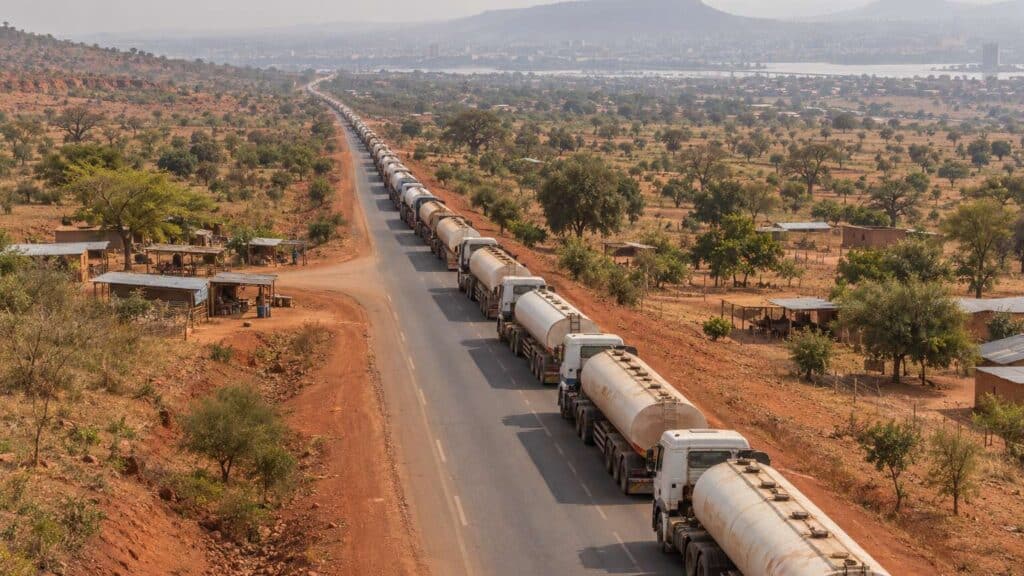
Since 3 September 2025, a West African capital has been living to the rhythm of queues outside petrol stations. In Bamako, fuel has become scarce — not because of a global shortage, but because an armed group decided to cut off access to it. By methodically targeting the fuel tankers that link the coastal ports to landlocked Mali, Jama’at Nusrat al-Islam wal-Muslimin (JNIM), affiliated with al-Qaeda, has turned energy supply into a lever of war. This “Bamako blockade” is not an isolated episode: it is a new grammar of the Sahelian conflict, in which the economy becomes the battlefield. For companies, humanitarian organisations and transporters operating in the region, understanding how it works is not a theoretical exercise — it is a matter of operational continuity.
What is the Bamako blockade?
The blockade refers to the campaign launched by JNIM to strangle Mali’s hydrocarbon supply. On 3 September 2025, its spokesperson Abou Houzeifa al-Bambari announced it in a video released by the group’s propaganda outlet. The initial stated objective was to obtain the lifting of fuel taxes in rural areas; it quickly turned into an instrument of political pressure against the military transition led by General Assimi Goïta.
JNIM is not a new actor. This coalition of jihadist groups formed in 2017 and affiliated with al-Qaeda is today the most active non-state armed force in the central Sahel. Its rise is part of the rivalry with the Islamic State in the Greater Sahara (ISGS) and, more broadly, of the continuing deterioration of security in West Africa. What is new is the method: rather than confronting the army head-on, the group has chosen to choke the economy.
The mechanics of asphyxiation: how JNIM turns off the tap
Mali’s vulnerability is structural. A landlocked country, it imports almost all its fuel — around 95% — via roads from Senegal and Côte d’Ivoire, supplemented by Guinea and, more marginally, Mauritania. The main axis between Senegal and Mali, National Road 1, crosses the Kayes region. That is precisely where the group concentrated its first strikes.
The first large-scale attack targeted a convoy of 80 tankers under Malian and Russian escort between Kaniara and Lakamane, in the Kayes region: satellite imagery counted more than fifty tankers at the site, around thirty of them burnt out. Since then, according to counts cross-checked by Bellingcat and ACLED, more than 300 fuel tankers have been destroyed. The modus operandi combines ambushes, convoy burnings and checkpoints where fighters levy “taxes” on transporters — a practice of road predation already documented in our analyses of the trafficking routes that fuel conflicts and of smuggling networks in the Sahel.
Import corridors turned into front lines
Three vital axes are affected: the Dakar-Bamako corridor (via Kayes), the Abidjan-Bamako corridor (attacked in the Sikasso region) and, more recently, the Conakry-Bamako axis, long considered relatively safe. These corridors are the logistical lungs of the Sahel: securing them is an issue we follow closely in our report on the security of regional trade corridors. By targeting them, JNIM is no longer attacking only the security forces: it is aiming at the backbone of the urban economy.
A strategy of asphyxiation, not mere ambushes
The Institute for Security Studies (ISS) speaks of a “strategy of asphyxiation” under way since September 2025, aimed at cutting off essential supplies entering and moving within the country. Fuel was not chosen at random: it is the good whose scarcity spreads fastest along the whole chain — transport, trade, electricity, public services. Turning fuel into a weapon means exploiting a dependency that the regional war economy, fed by fuel trafficking in conflicts, knows perfectly well.
A capital under strain: shortages, closed schools, departures of foreigners
In autumn 2025, Bamako tipped over. After nearly two months of blockade, the city did not receive a first secured convoy until 30 October. Residents waited for hours outside stations, with what little fuel was available reserved as a priority for military and government facilities. Public transport seized up; dozens of minibuses were left immobilised for lack of diesel.
The repercussions quickly went beyond mobility alone. The authorities closed schools and universities from 26 October to 9 November 2025, as reported by the BBC and documented by Human Rights Watch. Foreign ministries reacted: on 28 October, the United States embassy urged its nationals to “leave immediately”, followed by the United Kingdom; both withdrew part of their diplomatic staff. The United Nations drew on its emergency stocks. In January 2026, the government announced rationing. For organisations present on the ground, these signals point to concrete concerns that we address in our guides on protecting expatriate workers and reducing the risk of staff kidnapping — all the more so since, as early as 4 September 2025, six Senegalese drivers had been kidnapped before being released four days later.
A regional shockwave: Dakar, Abidjan and the coastal countries
The blockade extends well beyond Mali’s borders. Senegal is on the front line: Mali was its leading customer in 2024, absorbing 26.5% of its exports (around CFA 802.8 billion). Between September and November 2025, the port of Dakar recorded a daily blockage of around 120 containers bound for Mali, an estimated monthly loss of CFA 15 billion for Senegal. In early 2026, nearly 4,000 empty containers were still stuck in Bamako, with drivers no longer daring to take the road back to Dakar.
Côte d’Ivoire has not been spared: Mali remains its leading customer within WAEMU, and the Abidjan-Bamako corridor, through which around 1.47 million tonnes of goods passed at the end of 2025, is now suffering attacks in the Sikasso region. Burkina Faso, also dependent on Ivorian, Ghanaian and Senegalese ports, is seeing the threat spread: on 14 February 2026, seven Ghanaian traders were killed in an attack attributed to JNIM in Titao, in the north of the country. This interdependence, weakened by the realignments between ECOWAS and the Alliance of Sahel States, makes the blockade a test for the entire sub-region — a risk mapped in our map of security risks in West Africa.
Bamako’s response and its limits
Faced with the siege, the Malian authorities have multiplied their responses. Convoys under military escort have allowed 200 to 300 tankers a week to enter since November 2025; on 1 May 2026, the Directorate-General for Trade announced the arrival of 830 fuel tankers in Bamako. A general was specially appointed in early 2026 to “win the fuel war”. On the ground, securing supplies relies on the resources of the Sahelian armies, the support of Russian auxiliaries — whose real influence on the regional balance we have assessed — and the growing use of Turkish drones, an illustration of the drone war that is reshuffling the cards in the Sahel. Moscow even announced the delivery of 200,000 tonnes of petroleum products.
These responses quickly showed their limits. Le Monde reported a truce negotiated until Eid al-Adha, in exchange for the release of detainees — but the attacks continued and the army denied any negotiation. Above all, on 25 April 2026, a series of coordinated assaults by JNIM and the Azawad Liberation Front (FLA) struck Kati, Mopti, Sévaré, Gao and Bamako, killing the Minister of Defence, Sadio Camara. Five days later, JNIM reimposed a blockade on the capital via the western axes, paralysing the Kita-Bamako road. Far from being lifted, the siege operates in fits and starts.
What the blockade changes for the security of operations
For a security manager or a logistics coordinator, the Bamako blockade marks a shift: corridor risk is no longer incidental, it is structural. Three lessons stand out. First, continuity of supply — fuel, but also generators, inputs and foodstuffs — must be mapped and made redundant, because the failure of a single road link can freeze an entire operation. Second, the vulnerability of convoys and their crews becomes a central checkpoint: kidnappings of drivers, ambushes and taxation checkpoints require detailed analysis of routes and travel windows. Finally, the threat is moving far from the classic “red zones”, to the edges of major roads and capitals, which widens the perimeter to be monitored — including for major infrastructure projects.
In this context, having a dated and geolocated reading of incidents, and a regularly updated realistic evacuation plan, is no longer optional. The blockade is not only a Malian crisis: it is a textbook case of economic warfare whose methods could tomorrow extend to other West African corridors.
FAQ — Bamako blockade
Why is there a fuel shortage in Bamako?
Because JNIM, a jihadist group affiliated with al-Qaeda, has since 3 September 2025 been targeting the fuel tankers that supply Mali from the ports of Dakar, Abidjan and Conakry. More than 300 tankers have been destroyed, sharply reducing fuel deliveries to the capital.
Who is behind the blockade of Mali?
Jama’at Nusrat al-Islam wal-Muslimin (JNIM), a jihadist coalition formed in 2017 and affiliated with al-Qaeda, the main non-state armed group active in the central Sahel. The blockade aims to put pressure on General Assimi Goïta’s military transition.
How long has the Bamako blockade lasted?
It was announced on 3 September 2025. Its intensity varies: the situation improved partially in early 2026 thanks to escorted convoys, but JNIM reimposed a blockade on the capital after the coordinated attacks of 25 April 2026.
What are the consequences for neighbouring countries?
Senegal and Côte d’Ivoire, Mali’s main trading partners, are seeing their export corridors paralysed: containers stuck in ports, losses estimated at several billion CFA francs and a risk of attacks spreading towards Burkina Faso and the coastal routes.
Anticipating risk rather than enduring it
The Bamako blockade illustrates a profound shift: in the Sahel, the most effective weapon is not always the rifle, but the ability to cut a road. For exposed organisations, the response lies in continuous, dated and actionable monitoring — the kind that turns a fragmented flow of information into concrete security decisions.