In the Sahel, gold finances the states as much as those who fight them. As the leading export of Mali and Burkina Faso, the mining sector is an economic pillar — and, as such, a prime target. The Boungou ambush (Semafo) in November 2019, which killed nearly 38 employees being transported by bus under military escort, remains the most brutal warning: in these theatres, it is not only the sites that are targeted, but the convoys, the access routes and the people.
For a mining, energy or construction operator, securing a site is no longer a support function: it is a condition for operating. Burkina Faso recognised this by approving, in December 2025, a national strategy for securing mining sites (2026-2030). This guide reviews the real threats around a mining site in the Sahel and proposes a practical security set-up, from diagnosis to crisis governance.
Why mining sites are prime targets
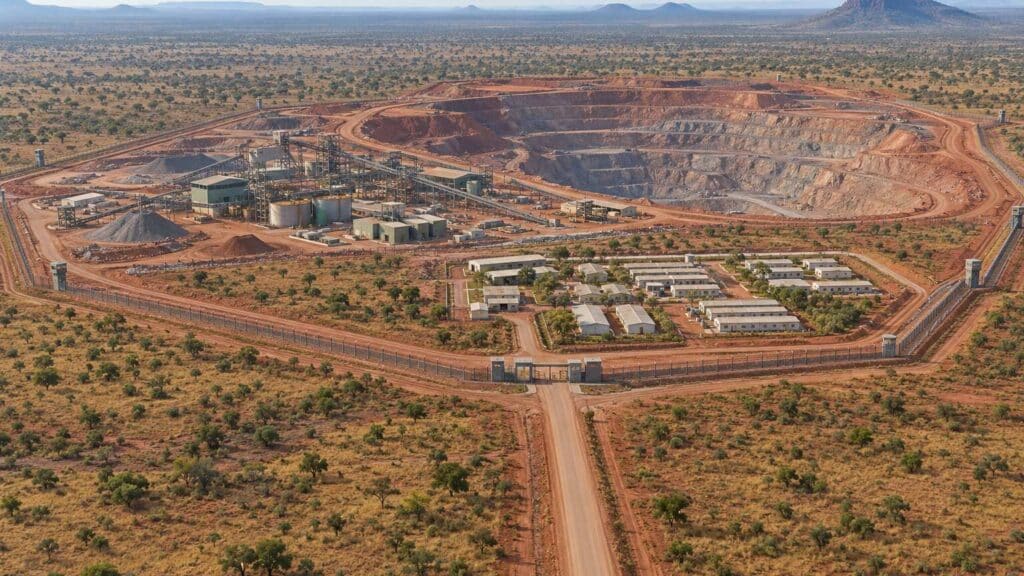
Three logics combine. First, value: gold is a liquid resource, coveted by armed groups that tax, extort or directly exploit artisanal gold mining to finance themselves — a mechanism we detail in why artisanal gold attracts armed groups and do cross-border mines fuel armed groups. Second, geography: industrial sites are often isolated, in peripheral areas poorly covered by the state, at the end of single tracks. Finally, visibility: a mine employs hundreds of people, follows predictable rotations and symbolically embodies the state and foreign capital — it fits into the targeting logic applied to major infrastructure projects.
Mapping the threat around a site
Before any set-up, the threat must be named where it actually strikes.
Convoys and access routes: vulnerability No. 1
The weak point is almost never the fenced perimeter: it is the road. Boungou (2019), then the repeated attacks on convoys of the Essakane mine (IAMGOLD) or, in Mali, the attack on a mining convoy despite its army escort (five dead), confirm this: resupply, staff rotation, removal of production and fuel delivery are the most exposed moments. A site’s security therefore depends first and foremost on its supply corridors.
Direct attack and harassment
Improvised explosive devices (IEDs) on tracks, motorcycle commando assaults, indirect fire, and now an aerial threat: the widespread use of drones adds a vertical dimension to the risk, for observation as well as for strikes. Harassment aims as much to kill as to discourage operations and force a withdrawal.
The immediate environment: artisanal mining, crime, infiltration
Around large sites, informal gold mining, banditry and networks that can serve as intelligence relays for attackers proliferate. The boundary between community rivalry, crime and armed threat is porous: security does not stop at the fence.
Building a site security set-up
Layered physical security
The principle of defence in depth remains the benchmark: a deterrent perimeter, strict access control (badges, searches, management of visitors and subcontractors), detection means (lighting, cameras, patrols), guard posts and a hardened assembly point. No single layer stops a determined assault on its own; stacking them buys the time needed to raise the alarm and respond.
Security of movements and convoys
Since the road is the weak point, that is where the effort must be focused: planning and approval of journeys, chosen movement windows, variation of routes and timings, spacing and discretion of convoys, redundant communications and rehearsed emergency procedures. An armed escort is useful but never replaces these fundamentals — escorted convoys have also been hit.
The human factor and subcontractors
Most victims are national employees and drivers. Awareness training, exercises, vetting of contractors, and a genuine duty of care policy are as fundamental as walls. These measures tie in with reducing kidnapping risks and protecting workers, national and expatriate alike.
Coordination with the security forces
In Burkina Faso, securing mines mobilises the armed forces, including the rapid intervention battalions (BIR), and now falls within the 2026-2030 national strategy. This is valuable support, but it calls for two precautions: not resting all security on a state system under strain, and providing a legal and ethical framework for the use of public forces or private security companies.
Governance: from the security plan to the crisis unit
A set-up is only as good as the governance that runs it. A site security plan documents threats, measures, roles and thresholds; a crisis unit equips decision-making when the situation deteriorates. The signs of local security deterioration must be monitored and linked to action levels — from reinforcement to suspension of activity, up to evacuation, the method for which is detailed in how to prepare a realistic evacuation plan. The underlying question — should one still invest despite insecurity — is better settled with a credible security set-up than by guesswork.
Anticipate rather than endure: monitoring as the foundation
All this requires seeing what is coming: knowing how the threat is evolving around each site and each route, dating incidents, spotting weak signals before they turn into an attack. That is the contribution of structured monitoring — beyond surveillance technologies alone — which aggregates information, maps it and delivers it as decision-making indicators. This is the purpose of the Sahel Watch monitoring platform, designed for security managers and operators present in West Africa.
FAQ
Are mining sites particularly targeted in the Sahel?
Yes. Their economic value, isolation and visibility make them recurring targets, directly (attacks on sites and convoys) and indirectly (taxation of artisanal mining, pressure on communities). The Boungou ambush (2019) and the attacks on Essakane convoys illustrate this.
How can a mining convoy be secured?
Through planning (movement windows, varied routes and timings), discretion, redundant communications, rehearsed emergency procedures and, where relevant, an escort — bearing in mind that an escort does not replace these fundamentals, as escorted convoys have already been attacked.
Should one rely on the army to protect a mining site?
Support from the forces (escorts, rapid intervention battalions, the national strategy for securing mines) is useful but not sufficient: the operator needs its own security set-up and must provide a legal framework for any use of public or private forces.
When should a mining site be suspended or evacuated?
When thresholds defined in advance are reached (deterioration on access routes, a credible threat to the site, inability to ensure staff security). Hence the importance of a security plan with action levels and a tested evacuation plan.
Sources and references
- Jeune Afrique — “Sahel: mining operators under terrorist threat”.
- Sidwaya — Burkina Faso’s national strategy for securing mining sites (2026-2030), approved in December 2025.
- Agence Ecofin — Mali: attack on a mining convoy escorted by the army.
- Business & Human Rights Resource Centre — attack on the Boungou mine (Semafo), November 2019.