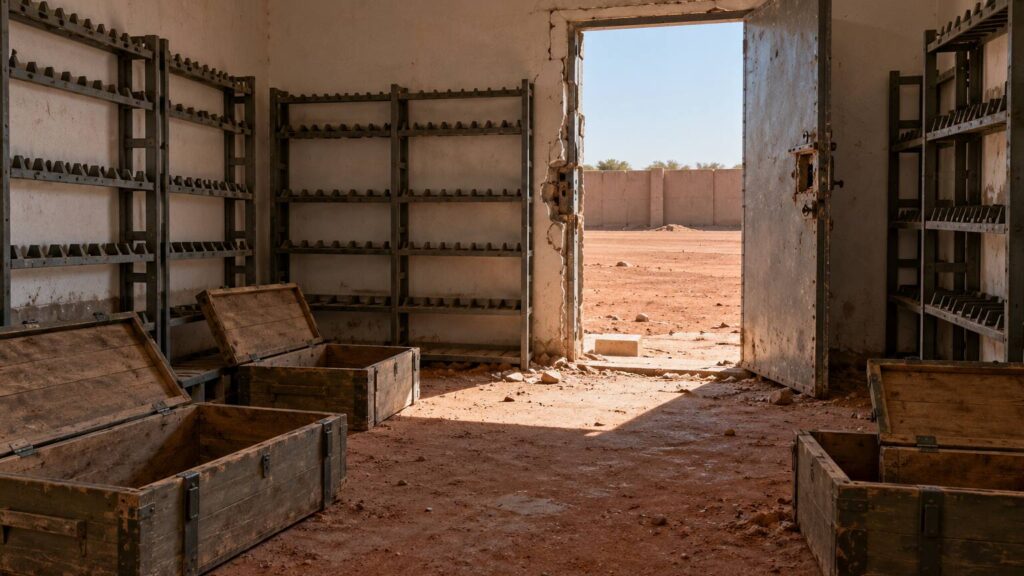
On 9 August 2026, JNIM fighters arriving on motorbikes, some wearing Malian army uniforms, attacked the main military camp in San, in central Mali. At least twelve soldiers were killed and military equipment was taken (RFI via allAfrica, 10 August 2026). Two months earlier, the gendarmerie in Tahoua, Niger, presented a batch of assault rifles, ammunition and motorbikes seized in the region (Le Sahel, 5 June 2026). These two facts sum up arms trafficking in the Sahel: some weapons are taken from armies, others pass from hand to hand on markets that seizures barely dent.
Where do the Sahelian armed groups’ weapons come from? The most widespread answer, “from Gaddafi’s arsenals”, is largely outdated. This article reviews the four documented sources, the routes and the markets, then what this changes for an organisation present on the ground. It complements our analyses of the trafficking routes that fuel conflicts and of smuggling networks in the Sahel.
The short answer: mostly locally
The most comprehensive study to date was published in April 2025 by Conflict Armament Research (CAR), a British organisation that traces the origin of weapons seized in conflict theatres. Its investigators analysed 726 weapons seized between 2014 and 2023 from jihadist groups, in the tri-border area (Burkina Faso, Mali, Niger) and in the Lake Chad basin, out of a total of 5,890 weapons documented in the region (AFP via The Guardian Nigeria, 29 April 2025).
Their conclusion: jihadist violence in the Sahel is fuelled above all by weapons already present in the region. CAR found no evidence that these groups directly obtain assault rifles, machine guns, mortars or rocket launchers from sources outside the central Sahel. Four channels emerge.
| Source | What is documented | Trend |
|---|---|---|
| National army stocks | At least 20% of seized weapons, taken during attacks or diverted (CAR) | Rising with attacks on camps |
| Weapons “inherited” from past conflicts | Rifles from the 1960s-1970s bought on local markets; post-2011 Libyan weapons: 7% of seizures | Old stock that continues to circulate |
| Illicit markets and cross-border trafficking | New rifles arriving from Libya since 2019, small flows from coastal countries (UNODC, Small Arms Survey) | Seizures up 105% between 2017 and 2021 |
| Craft production and diverted civilian equipment | Forged weapons, craft pistols, modified commercial drones | Drones on the rise |
1. Army arsenals, the leading identified source
According to CAR, at least 20% of the weapons analysed come directly from the stocks of the national armies of Burkina Faso, Côte d’Ivoire, Liberia, Libya, Mali, Niger, Nigeria and Chad. Leo Jarry, co-author of the report, considers this figure probably underestimated. More than half of the small-calibre ammunition seized had been manufactured less than ten years before its recovery, and a good part had been delivered to the armies of the central Sahel or diverted from their allocations (Africa Defense Forum, 20 May 2025).
Looting of military camps
As early as 2020, the Institute for Security Studies (ISS) identified attacks on isolated posts as the main source of heavy weapons for jihadist groups. The 2019 assaults on Inates (Niger), Indelimane (Mali) and Koutougou (Burkina Faso) were followed by videos showing the spoils: machine guns, mortars, vehicles (ISS, 12 February 2020). The pattern has not changed: the attack on San in August 2026, like those of the major FLA–JNIM offensive of July 2026, also aims to seize weapons, ammunition and vehicles.
Matthew Steadman, the other co-author of the CAR report, speaks of a “vicious circle”: each post taken increases the group’s capacity to attack another. This is one of the reasons why the question of whether national armies can hold out alone is also a logistical one.
Diversions outside combat
Not all weapons of state origin are taken by force of arms. CAR and the ISS also cite poor stock management, unreported losses and resales. The 2025 report stresses that the illicit circulation of these diverted weapons remains to be documented. Notably, JNIM and the Islamic State in the Sahel, which fight each other in Liptako-Gourma, use weapons from the same production series: this suggests common supply circuits rather than separate suppliers (see our analysis of the JNIM–ISGS rivalry in Mali).
2. Libya: a real reservoir, but not the main supplier
The fall of Muammar Gaddafi in 2011 released stocks accumulated over forty years. Tuareg fighters from the Libyan army returned to Mali with their weapons, and the 2012 rebellion benefited greatly. But according to the ISS, these flows declined from 2013, as a result of military deployments at the borders and the demand created by the Libyan civil war itself.
CAR’s data confirm this decline: post-2011 Libyan weapons account for only 7% of the seized weapons analysed, and Gaddafi-era rifles were most often bought on local markets, not imported directly. Libya nonetheless remains an active source for part of the market. The United Nations Office on Drugs and Crime (UNODC) reports that, since 2019, recently manufactured assault rifles have been arriving from Libya (UN News, June 2023). The Libya–Algeria–Niger–Menaka route remains the main north-south axis, and southern Libya also serves as a rear base for non-jihadist movements, such as the rebel groups of northern Niger.
3. Illicit markets and the “ant trade”
Between the looted barracks and the fighter, there is a market. The Small Arms Survey distinguishes two systems. North of the Niger River, organised networks move significant quantities over long distances. To the south, trafficking relies on small flows and local intermediaries, the “ant trade”, which crosses in particular the Burkina Faso–Côte d’Ivoire–Mali and Ghana–Côte d’Ivoire–Burkina Faso border areas (Small Arms Survey, December 2019).
Prices and points of sale
UNODC noted in 2023 that an AK-type rifle sold for around $750 in the Gao, Timbuktu and Menaka regions, and a cartridge for around 70 cents. Markets are tucked away in the towns and villages of strategic corridors, where the state has little presence. Liptako-Gourma is both a battlefield and a trading place. Towns located at the junction of three borders, between Burkina Faso, Niger and Nigeria, act as hubs, according to the ISS ENACT programme (ISS/ENACT, December 2023).
These markets intersect with other illicit economies. CAR reports that some Liptako-Gourma groups occasionally resell captured weapons, most often for gold, to pay their fighters or obtain supplies. The link with the gold economy and with other trafficking, from cocaine to fuel, is direct: the same routes, the same transporters, sometimes the same intermediaries. Ransoms also fuel purchases. UNODC cites a suspect who told the Nigerian authorities that his group had spent a $100,000 ransom on “additional rifles”.
Bamako, an urban hub
The phenomenon is not only rural. A field study conducted in Bamako between 2021 and 2022 describes weapons brought in via the Niger River and the trans-Saharan road, as well as clandestine workshops set up on the outskirts. Between 2014 and 2020, the security forces seized 300 assault rifles, 49 craft weapons and 22 machine guns there (The Conversation). Not all buyers are jihadists: bandits, self-defence militias and individuals seeking to protect themselves feed the same demand.
4. Craft production and civilian drones
Blacksmiths in the region have long made hunting rifles and craft pistols. These weapons count for little in fighting against armies, but for a great deal in intercommunal violence and banditry. On market stalls, they sit alongside smuggled handguns and machine guns, according to UNODC.
What is new comes from diverted civilian equipment. In March 2025, ISWAP used explosive-laden drones against a base in Wulgo, Nigeria, killing twelve Cameroonian soldiers of the multinational force. CAR notes that drone supply chains remain limited in much of the Sahel, which slows their spread. The trend is nonetheless clear, as we analysed in the drone war in the Sahel: a commercial drone can be bought legally, is easy to transport and appears on no weapons register.
Why seizures are not enough
States regularly publicise their seizures. In Mali, 490 weapons and 1,915 rounds of ammunition were seized in 2024, and 78 weapons handed in voluntarily, according to the Ministry of Security (APA News, 2 February 2025). In Chad, 302 weapons, 119 magazines and 25 rounds of ammunition were taken from civilians in three months in Salamat province (Tchadinfos, 31 July 2026). UNODC notes that seizures in the region increased by 105% between 2017 and 2021.
These figures remain low compared with the stocks in circulation, and they measure the activity of the security forces as much as the scale of trafficking. Above all, they do not touch the leading source identified by CAR: weapons taken from armies. As long as isolated posts remain vulnerable and stock traceability remains weak, every successful attack resupplies the attackers. The ISS was already recommending strict depot management, weapon marking and accountability of holders in 2020. UNODC, for its part, stresses the lack of reliable national data, which prevents flows from being tracked from one country to another.
What this changes for an organisation present in the Sahel
- Proximity to military posts is a risk factor. Since armed groups equip themselves by attacking camps and posts, a living base, a warehouse or a route close to an isolated defence force position inherits part of its exposure. This criterion must be included in site analysis and route selection (see road convoy security and mining site security).
- A spike in attacks on camps often heralds a build-up. Weapons, ammunition and vehicles recovered during an offensive reappear in subsequent operations. Tracking the frequency and toll of attacks on defence forces in an area gives an early signal of deterioration, useful for adjusting alert levels before the threat reaches civilian routes.
- Trafficking routes are also threat routes. The corridors through which weapons, gold and fuel move concentrate armed groups, informal checkpoints and banditry. The map of security risks in West Africa makes it possible to identify them area by area, and the duty of care requires them to be taken into account in staff movements.
What we do not know
Public data rest on samples of seized weapons, which are necessarily partial: what is captured is not representative of everything in circulation. The real share of weapons diverted outside combat, through resale or corruption, is not measured. The reference reports date from 2019 to 2025 and do not yet cover the effect of the major 2026 offensives in Mali, nor the military realignments under way in the AES countries. Finally, attack tolls and inventories of spoils released by armed groups are propaganda and cannot be independently verified.
FAQ
Where do jihadists’ weapons in the Sahel come from?
Mainly from the region itself. According to Conflict Armament Research, at least 20% of the weapons seized from jihadist groups between 2014 and 2023 came from national army stocks. The rest comes mostly from old weapons bought on local markets, cross-border trafficking and, marginally, craft production.
Do Libyan weapons still arm groups in the Sahel?
Only in part. Post-2011 Libyan weapons account for only 7% of the seizures analysed by CAR. UNODC nonetheless reports new assault rifles arriving from Libya since 2019, via the Libya–Algeria–Niger–Menaka route.
How much does a Kalashnikov cost in the Sahel?
UNODC noted in 2023 a price of around $750 for an AK-type rifle in the Gao, Timbuktu and Menaka regions, and around 70 cents per cartridge. Prices vary according to the area, the condition of the weapon and security pressure.
How can arms trafficking in the Sahel be tackled?
The recommendations converge: securing and tracing military stocks, strengthening the protection of isolated posts, better collecting seizure data and cooperating between neighbouring countries. Seizures alone are not enough as long as armies remain the main source of supply for armed groups.
Tracking attacks and flows, area by area
Knowing where armed groups equip themselves means anticipating where they will strike next. Sahel Watch helps security managers, NGOs and analysts continuously track incidents, attacks on defence forces and high-risk routes, so they can decide on the basis of dated and cross-checked facts.