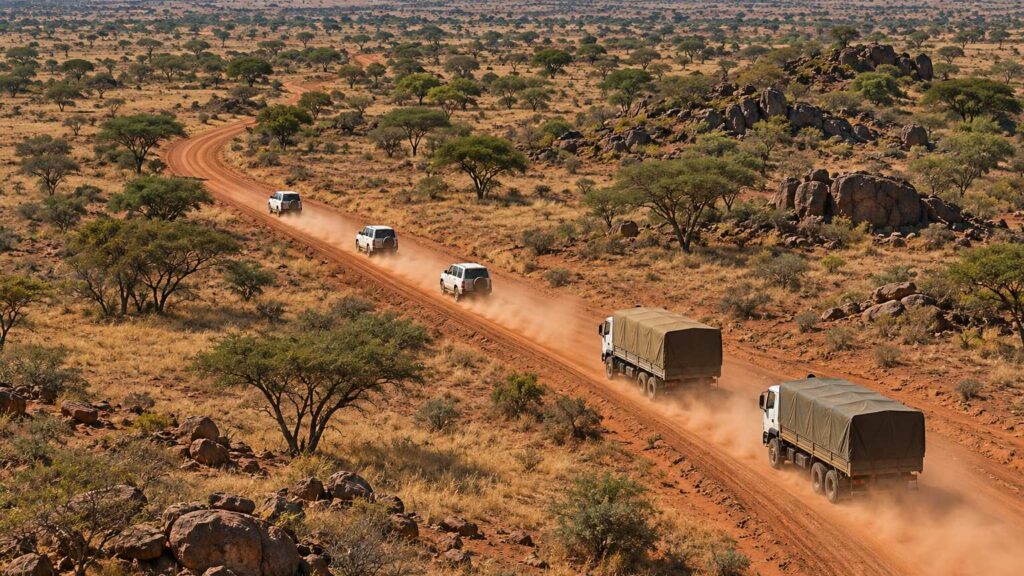
In the Sahel, the road is both the lifeline of the economy and the weakest link in security. Supplying cities under pressure, provisioning industrial sites, humanitarian logistics, regional transit: almost everything travels along long, exposed and predictable roads. In 2026, this reality has hardened. Around Bamako, the blockade weapon used by JNIM has forced the Malian army to escort huge convoys of tanker trucks — 807 on 26 June, more than 900 on 10 July, 850 on 31 July, around 800 on 15 August — to keep the capital supplied with fuel. In Burkina Faso, a supply convoy heading to the Essakane mine struck an improvised explosive device on the Dori road on 4 August 2026, killing around ten soldiers. For a security manager, the question is no longer “should we drive?” but “how do we drive without turning every journey into a gamble?”.
This operational guide sets out a practical approach to securing a road convoy in a Sahelian risk area: reading the threat, choosing the right movement doctrine, preparing vehicles and teams, and knowing how to react when an incident occurs. On the transport side, it complements our analysis of security arrangements for mining sites and our decision-making framework on the duty of care towards staff.
Why the road is the weak link in Sahel security
The stretches crossing central and northern Mali, eastern and northern Burkina Faso and western Niger combine several overlapping threats. Armed groups affiliated with al-Qaeda (JNIM) or the Islamic State (ISGS) carry out ambushes, targeted kidnappings and sabotage of infrastructure there. Added to this are armed banditry, fake checkpoints, the laying of improvised explosive devices (IEDs) on tracks, and opportunistic crime that thrives where the state has little presence. These threats do not weigh only on combat zones: they extend along the regional trade corridors linking coastal ports to landlocked countries.
The convoy is a prime target for three reasons. It is predictable: same roads, same times, same mandatory crossing points. It is observable: monitoring a moving convoy is relatively simple, and a grouped departure attracts attention well before the first kilometre. It is vulnerable to being broken up: the longer the convoy, the greater the risk of a vehicle becoming separated or the column stretching out, offering an attacker the isolated stretch it is looking for. Recent history is a reminder: the Gaskindé attack in September 2022 struck an escorted convoy of 150 trucks heading to Djibo and killed 27 soldiers and around ten civilians — a shock with major political repercussions. Escorted does not mean invulnerable.
Mapping the risk before driving: journey management
The first protection is not a rifle, it is a decision taken in advance. Journey management — the planned management of movements — consists of treating each journey as an operation in its own right, authorised only after analysis. Humanitarian security reference frameworks, such as the Good Practice Review on travel security, and the international standard ISO 31030 on travel risk management, converge on one principle: the mode of travel must stem from a documented risk analysis, not from habit.
Assess the route, not just the destination
The same destination can be reached via stretches of very different levels of danger. The assessment covers each segment: incident history, presence of red zones, points of vulnerability (bridges, fords, forests, villages under influence), quality of network coverage, emergency response times. Our zone-by-zone map of security risks and our tracking of the trafficking routes that fuel conflicts help place a road within the regional landscape. The aim is to classify each route — usable, usable under conditions, or to be avoided — and to define time windows: drive by day, avoid departures and arrivals at dusk, never stop at a known black spot.
Authorise, track, be able to cancel
A good set-up rests on a clear chain of authorisation: who approves a departure, on what criteria, and who has the power to suspend it. Each movement is recorded (route, times, composition, means of communication), tracked in real time and linked to regular checkpoints. The cancellation trigger must be defined before departure — a deteriorating threat, loss of communication, an incident on the road — so that it is not negotiated under pressure at the last minute.
Escorted convoy or low-profile movement? Two doctrines
There is no single answer. Two logics are opposed, and the right choice depends on the context, the nature of the load and the dominant threat.
High visibility: the armed escort
This is the doctrine of strategic supply convoys. Grouping dozens of trucks under military escort — like the mega-convoys of tankers to Bamako or the convoy of more than 300 trucks that left Fada N’Gourma for Diapaga in late 2025 — makes it possible to concentrate protection and force a way through on roads where travelling alone would be suicidal. The advantage is firepower and the deterrent effect. The limits are real: the convoy becomes a massive and predictable target, assembling it takes time, and a well-prepared IED or ambush can inflict losses despite the escort. This option is managed with the security forces, never by relying entirely on them.
Low profile: discretion and unpredictability
Conversely, for staff or sensitive but light cargo, discretion can protect better than force. Unmarked vehicles, small groups, varied routes and times, no distinctive markings, minimal communication on social media: the idea is not to be spotted or identified as a profitable target. This doctrine requires strict discipline (no conspicuous logos, no routine) and excellent knowledge of the terrain. It is ill-suited to large volumes, but often preferable for team movements, including humanitarian ones.
Composing and organising the convoy
Once the doctrine has been chosen, the practical organisation makes the difference between a controlled convoy and an exposed column.
- Prepare the vehicles: flawless mechanical maintenance (a breakdown isolates), reserve fuel and wear parts (tyres, belts), water and food, a first-aid kit, redundant means of communication (VHF radio and satellite phone where there is no network).
- Structure the column: a lead vehicle scouting the route, a rear vehicle bringing up the rear, constant safety distances between vehicles to avoid both stretching and over-concentration, and an order of march known to all.
- Allocate roles: a single convoy leader who decides, briefed drivers, a communications focal point. Everyone knows who is in command and whom to alert.
- Brief before departure: the security situation on the road, identified points of vulnerability, what to do in the event of an incident, emergency assembly points, emergency contacts. A short but systematic briefing is better than a long document that is never read.
- Track in real time: vehicle geolocation, regular check-ins with base, an alert procedure if a vehicle falls behind or contact is lost.
Incident procedures: deciding in a few seconds
The quality of the response depends on reflexes rehearsed in advance, not on improvisation. Procedures must be simple, known to all and adapted to the local terrain.
In an ambush, the general rule is to get out of the kill zone: do not stop at the point of attack, push through if the road remains open, divert to an identified fallback point if the way is blocked. Faced with an explosive device or a suspicious obstacle, do not force it: stop at a distance, make no hasty manoeuvre that could trigger a second device, raise the alert immediately. At a fake checkpoint, judgement comes first — assess whether it is a legitimate check or a trap, without sudden movements. In the event of a breakdown or accident, the vehicle in difficulty must never be left isolated: this is a convoy’s primary vulnerability. Each scenario benefits from being rehearsed beforehand, as an exercise, so that the decision is automatic when the day comes. The vertical threat should not be overlooked either: the rise of armed drones and the coordination demonstrated during the large offensive of July 2026 make it necessary to factor aerial observation into the analysis.
The human factor: drivers, subcontractors and duty of care
The most frequent blind spot is human. Much of the transport relies on independent drivers or subcontractors, often the most exposed and the least protected. Repeated attacks on truck drivers on Malian roads have highlighted a glaring lack of safeguards: insurance cover, support in the event of an incident, assistance for families. Yet a client’s responsibility does not end at the warehouse door.
Three requirements follow. First, selection and awareness: vet transport providers, train drivers in procedures, do not entrust a high-risk journey to an unprepared team. Second, cover: insurance suited to the areas crossed, an assistance and repatriation arrangement, a medical protocol. Finally, grounding in a genuine duty of care: normative frameworks such as ISO 31030 or the employer’s safety obligation require anticipating, informing and being able to call off a journey. A convoy’s security is measured as much by the protection of its drivers as by the strength of its escort. Humanitarian organisations, whose structured convoy procedures are documented by actors such as the Global Interagency Security Forum (GISF), offer references in this respect that can be transposed to the private sector.
Anticipate rather than endure
No escort replaces the decision not to drive at the wrong time. Convoy security in the Sahel is decided first and foremost in the crisis room: tracking the threat on the roads concerned, detecting deterioration before it turns into an ambush, and giving oneself the power to reinforce, postpone or suspend a movement. That is precisely the role of continuous security monitoring, cross-referencing incidents, actor dynamics and weak signals along the corridors — from eastern Burkina Faso to the border regions of Togo and northern Benin. To place each journey in the current regional context, our August 2026 security overview offers an up-to-date starting point.
Frequently asked questions
Is a convoy escorted by the army really safe?
Safer, not invulnerable. An escort concentrates protection and deters many attacks, but escorted convoys have been hit, as at Gaskindé in 2022 or on the Dori road in August 2026. An escort is one means among others: it does not remove the need for route analysis, incident procedures or team preparation.
Is one large convoy better than several small movements?
It depends on the load and the threat. A large escorted convoy is needed to force a dangerous road with volume (fuel, supplies). For staff or light cargo, several discreet, unmarked and unpredictable movements often reduce exposure more effectively. The choice must result from a risk analysis, not from habit.
What should you do in an ambush or when facing a suspicious obstacle?
The general rule is to get out of the danger zone without stopping in it: push through if the road remains open, otherwise divert to a fallback point. Faced with a suspected explosive device, stop at a distance without sudden manoeuvres and raise the alert. These reflexes must be rehearsed in advance so that they become automatic.
How can subcontracted drivers be protected?
By treating them as staff to be protected: selection and training, systematic briefings, insurance suited to the areas crossed, assistance and a medical protocol, and inclusion in the company’s duty of care. The client’s responsibility does not end when the truck leaves.