On 25 October 2026, both chambers of the Algerian parliament authorised the dispatch of units of the People’s National Army (ANP) to Niger. The next day, President Abdelmadjid Tebboune ordered the mission. A week later, a detachment reached Arlit and a first convoy of Algerian fuel arrived in Agadez. For the first time since the October 1973 war, Algeria is sending troops beyond its borders, and it is doing so in northern Niger, an area that oil, mining and humanitarian operators know for its isolation.
This analysis sets out what has been decided, what is actually on the ground at the end of November 2026, and what the arrival of a new state armed actor changes for organisations operating in Niger. It complements our background reading on relations between Niger and Algeria, published before this deployment.
From fighter jets to a convoy: the timeline of a gradual commitment
The deployment voted in October is not a starting point. It formalises an Algerian military presence that has been building up in stages since the summer, in response to the fragility of the government in Niamey after the mutiny of 28 and 29 August.
| Date | Event |
|---|---|
| 10/07/2026 | Algiers and Bamako announce the return of their ambassadors and the reopening of their airspace, after the crisis triggered by the downing of a Malian drone in April 2025 |
| Early August 2026 | Four Algerian helicopters sent to Niger (ADF) |
| 13/08/2026 | Ceremony at the Kafra oil block (Agadez region) attended by the prime ministers of both countries; Sonatrach announces a four-well campaign |
| 30/08/2026 | The day after the mutiny, four Su-30 fighters, a transport aircraft and a tanker land at Air Base 101 in Niamey |
| 21/10/2026 | Military cooperation protocol signed in Algiers by the ANP chief of staff, Saïd Chanegriha, and Niger’s defence minister, Salifou Mody |
| 25/10/2026 | The Council of the Nation, then the People’s National Assembly, approve sending ANP units to Niger |
| 26/10/2026 | President Tebboune authorises the mission |
| 30-31/10/2026 | A military convoy reaches Arlit (Reuters); some sixty escorted fuel trucks arrive in Agadez |
| 09/11/2026 | Niamey summons the European Union chargé d’affaires, after an EU spokesperson asked on 30 October for clarification of the scope, purpose and legal basis of the deployment |
Source: Al Jazeera, ADF, Algérie Brèves News citing Reuters, Cameroon Tribune, Mondafrique, Sahel Watch, as of 24 November 2026.
Why Algeria is breaking with fifty years of non-intervention
Algerian doctrine rested on three principles: sovereignty, non-interference and opposition to foreign military intervention. Algiers defended them in 2011 against the intervention in Libya, then in 2023 against the military option considered by ECOWAS after the coup in Niger. That stance, recalled by several analysts, partly explains the trust Niamey now places in its northern neighbour.
The obstacle was legal as much as political. The constitutional revision of November 2020 opened, in Article 91, the possibility of sending ANP units abroad by decision of the president, provided that two thirds of the members of each chamber agree. Foreign Minister Ahmed Attaf defended the request before the Council of the Nation, where it was adopted unanimously.
Geography is the final factor. Algeria shares a 951 km border with Niger and a 1,359 km border with Mali. Rebellions in northern Niger, entrenched banditry and the arrival of fighters from Chad and Libya make this area a national security issue for Algiers. Michaël Ayari, an analyst at the International Crisis Group, describes “continuity in concerns, but a change of means”.
“A taboo seems to have lost its force.”
Akram Kharief, Algerian defence analyst, on a deployment made at the request of a neighbouring state, quoted by ADF, October 2026
What the ANP is there to protect: an oil block, a gas pipeline and a corridor
The official justification is economic. Algerian lawmakers presented the mission as protecting Algeria’s energy and economic interests in Niger, not as taking part in counter-terrorism. Three assets are at stake.
The Kafra block
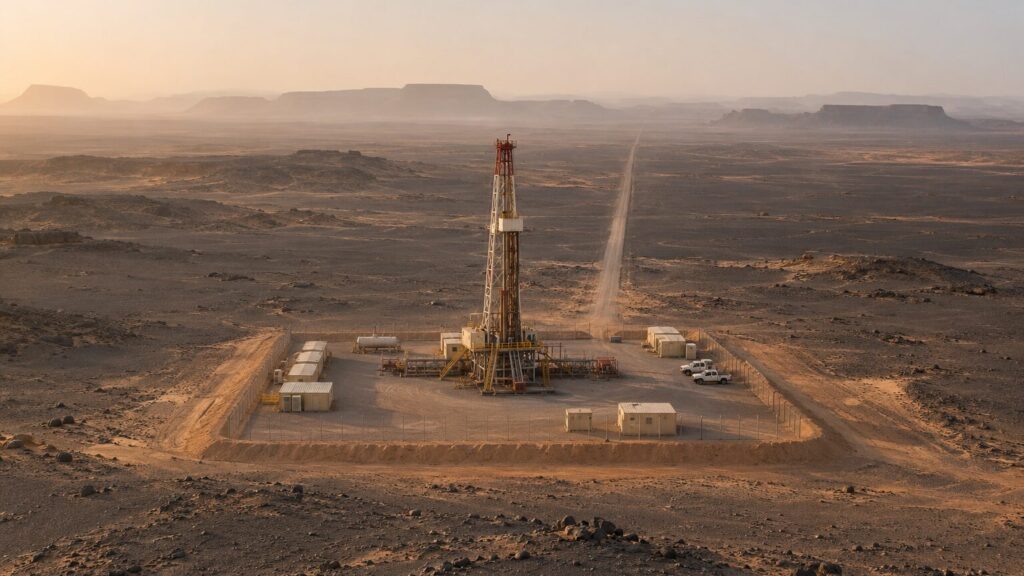
Sonatrach has held the Kafra licence in the Agadez region since 2005, through its exploration and production subsidiary Sipex. Two wells drilled in 2018 and 2019 led to the Kafra-1 discovery. A four-well campaign was announced in August 2026 to confirm the productivity of the reservoirs.
Note
Kafra is not a producing field. The licence is still at the exploration and appraisal stage. Protecting a site whose economics remain uncertain suggests that the stakes go beyond the asset itself.
The Trans-Saharan gas pipeline
The project is meant to link Nigeria’s gas fields to the Algerian network, and then to European markets, over more than 4,100 km, with a planned capacity of 30 billion cubic metres a year. Around 2,400 km already exist on the Algerian and Nigerian sides; most of the remaining 1,600 km cross Niger, through areas exposed to armed groups and trafficking. The pipeline competes with the Nigeria-Morocco project along the Atlantic coast: demonstrating the security of its route is part of the battle for influence, as Crisis Group points out. Our analysis of the risks facing regional oil and gas pipelines details these vulnerabilities.
The fuel corridor
The ANP’s first visible move was logistical: an escort accompanying some sixty fuel trucks to Agadez, overseen by the Algerian consul, in a northern Niger hit by shortages. The volume and recipients of the cargo have not been made public. For operators, this is the most concrete sign: Algeria is positioning itself as supplier and guarantor of a north-south supply route, while roads to the Gulf of Guinea ports remain constrained.
Where the ANP will be based, and what that will say about the mission
Neither troop numbers, duration, mandate nor rules of engagement have been published. On 20 November, Ibrahim Yahaya Ibrahim, deputy director of Crisis Group’s Sahel project, observed that there was “not yet a massive deployment of Algerian troops in Niger”. The location will be the most telling indicator.
- Kafra or Arlit: a presence around oil and mining sites would confirm an infrastructure protection mission, in line with the official line.
- Madama, in the far north-east near Libya: a base for monitoring the Sahelo-Saharan belt and the Libyan border, raised by a former Algerian diplomat, without confirmation.
- Niamey: a presence in the capital would point to a mission focused on protecting the government rather than installations, according to Crisis Group’s reading. Air Base 101, which already hosts the Algerian aircraft, is also home to the command post of the AES Unified Force and to personnel of Russia’s Africa Corps.
Lotfi Sour, a lecturer and researcher at the University of Mascara, sums up the dilemma: protecting a facility secures neither the roads leading to it nor the surrounding population, and the wider the area to be protected, the greater the risk that the mission drifts beyond its original purpose.
One more actor in an already crowded north
Northern Niger now hosts several armed actors with different logics. The MPLJ, FPL and CFLN rebellions target the security forces and oil installations, with rear bases in Libya and Chad. Niger’s defence and security forces, stretched in the west against JNIM and Islamic State Sahel, lack the numbers to hold every front. Algerian support is meant to fill that gap.
The deployment is also part of rivalries that reach beyond the Sahel. Algeria severed diplomatic relations with the United Arab Emirates in September 2026. Crisis Group describes competition with the camp of Field Marshal Haftar, backed by Abu Dhabi, for control of flows through the Salvador Pass, where the Algerian, Libyan and Nigerien borders meet. Niamey is hedging its bets: in early November, Prime Minister Ali Mahaman Lamine Zeine signed a cooperation protocol in Benghazi with the authorities of eastern Libya.
Finally, Russia helped the thaw between Algiers and Bamako, but priorities differ: Algiers advocates a political way out of the crisis in northern Mali, while Moscow and the Africa Corps favour a military solution, including against the Azawad Liberation Front. Russian influence and Algerian influence now coexist in Niamey, on the same air base.
Watch point
By seeking Algiers’ support, Niamey may inherit its ally’s adversaries. Armed groups in the north, like networks linked to eastern Libya, could come to see convoys and sites protected by the ANP as new targets. No attack of this kind had been reported as of 24 November 2026.
What this changes for organisations operating in Niger
For a company, NGO or institution operating in Niger, three effects should be monitored now.
- A new map of routes. If the Agadez escort becomes regular, the Algeria-Agadez route may become more reliable for fuel and freight. It still crosses areas where rebels and armed gangs operate: a foreign escort does not make the route secure. The principles in our guide to road convoy security apply.
- One more counterpart around sites. Oil and mining operators in the north, notably around Arlit and the Agadem block, will have to factor an additional foreign military actor into their security plans and local coordination, alongside Nigerien forces and Russian partners. See our guide to mining site security.
- A diplomatic risk to factor in. The tense exchange between Niamey and the European Union over this deployment is a reminder that relations with Western donors remain fragile. An organisation funded by Europe should plan for the effect of new tensions on its permits, visas and channels of dialogue. Our security risk assessment method helps to revise these scenarios.
What we do not know yet
Three points remain open as of 24 November 2026. Troop numbers and the duration of the mission have not been published, and nothing confirms that the Arlit detachment stayed on site. The exact mandate, in particular whether the ANP may conduct offensive operations or aerial intelligence from Air Base 101, is not known. Finally, no announcement has been made on coordination with the AES Unified Force or with Mali, whose border with Algeria remains sensitive. Any reading of the security impact should therefore stay cautious, and dated.
Frequently asked questions
How many Algerian soldiers are deployed in Niger?
No official figure had been published as of 24 November 2026. The only documented ground presence is a detachment that reached Arlit at the end of October and the escort of a fuel convoy to Agadez. Algerian aircraft and helicopters have been stationed in Niger since August.
Why is Algeria sending its army to Niger?
Officially, to protect its energy and economic interests, in particular the Kafra oil block explored by Sonatrach and the future Trans-Saharan gas pipeline. Analysts also see a wish to secure its southern border and to carry weight against the other powers present in the Sahel.
Is this Algeria’s first military intervention abroad?
It is the first dispatch of troops beyond its borders since Algeria took part in the October 1973 war. It was made possible by Article 91 of the Constitution as revised in 2020, which requires the agreement of two thirds of each chamber of parliament.
Is the Algerian army fighting jihadist groups in Niger?
Nothing indicates this at this stage. Algerian lawmakers presented the mission as securing infrastructure, and Crisis Group considers that counter-terrorism does not appear to be its main objective. The mandate and rules of engagement have not been made public.
Do you move staff or freight in northern Niger? See the incidents on your routes in 20 minutes.
Sources: Al Jazeera, 26 October 2026; ADF, October 2026; Algérie Brèves News, 1 November 2026; The Conversation, 1 November 2026; Mondafrique, based on Crisis Group’s Afrique 360° podcast, 21 November 2026. See also our November 2026 overview, our profile of the Alliance of Sahel States and the map of security risks in West Africa.