On 4 November 2026, Benin’s Council of Ministers replaced the country’s entire military high command in one go: the chief of the general staff and the heads of the army, the National Guard, the air force and the navy. A week later, on 11 November, Operation Mirador, which leads the fight against armed groups in the north, also changed commander. These are the first decisions of this scale since President Romuald Wadagni took office on 24 May 2026, and they come in the coastal state hit hardest by the spread of the Sahel threat.
This profile sets out who does what among Benin’s defence and security forces (FDS) at the end of 2026: the components, their known leaders, the Mirador deployment, partners, and what these changes mean for an organisation operating in the country. For neighbouring Niger, see our profile Niger’s defence and security forces: who does what in 2026?.
Benin’s security architecture at a glance
Benin has two main blocks. The Benin Armed Forces (FAB), under the authority of the president as supreme commander and of a minister delegate for National Defence, comprise the army, the air force, the navy, the National Guard and the Republican Guard. The Republican Police, the single internal security force, reports to the minister delegate for the Interior and Public Security. Since the government formed on 24 May 2026, both portfolios are ministries delegate attached to the presidency: Gildas Agonkan for National Defence and Djibril Maman Cissé Moussa for the Interior.
| Component | Main role | Known head (November 2026) |
|---|---|---|
| FAB general staff | Command of all armed forces | Lieutenant General Abou Issa |
| Army | Land operations, including the north | Colonel André Dokoui Fofo |
| National Guard | Intervention units and special forces, support to Mirador | Colonel-Major Saturnin Obelakou |
| Air force | Air support, helicopters, drones | Colonel Hervé Allotchenou |
| Navy | Coastline and the port of Cotonou | Captain Dossa Hounkpatin |
| Republican Guard | Protection of state institutions | Not published |
| Republican Police | Internal security, border posts, transport corridors | Inspector General Brice Kokou Allowanou |
Source: Council of Ministers of 4 November 2026 (Bénin Web TV, Le360), Government of Benin, as of 18 November 2026.
The Benin Armed Forces: from a peacekeeping army to a fighting army
Until 2019, Benin’s army was mainly used for internal security and United Nations peacekeeping. The kidnapping of two tourists and their guide in Pendjari park in May 2019, followed by the first attacks on military posts, changed its mission. A report by the documentation services of Belgium’s CGRA and France’s OFPRA, published on 25 June 2026, lists the difficulties the authorities themselves acknowledge: the length of the border areas, the mobility of armed groups and limited experience of asymmetric warfare.
The first response was budgetary and human. According to ADF magazine, the defence budget rose by 60% between 2022 and 2024, and a special drive to recruit 5,000 soldiers was launched. Benin has acquired helicopters, drones and armoured vehicles from partners, without publishing quantities. This build-up must be set against the losses: ADF estimates that 217 soldiers have been killed in combat in the north since Operation Mirador began.
The National Guard, spearhead in the north
Created within the FAB to support the fight in the north, the National Guard brings together intervention and special forces units. In July 2025, the “Bouclier” exercise mobilised 560 of its members in three southern departments, a sign that the unit is also designed for crises outside the north. Its former head, Colonel Faïzou Gomina, promoted to brigadier general after 7 December 2025, became the minister’s adviser for international military cooperation on 4 November 2026. Colonel-Major Saturnin Obelakou succeeds him. The unit has faced criticism: on 22 July 2024, according to ACLED, National Guard members fired on farmers at Gorou Béri (Karimama commune), killing two civilians mistaken for attackers.
The Republican Guard and the test of 7 December 2025
On 7 December 2025, a small group of soldiers calling themselves the “Military Committee for Refoundation”, led by Lieutenant Colonel Pascal Tigri, attacked the presidential residence and the homes of several officers, took two generals hostage and announced on state television that President Patrice Talon had been removed. The attempt failed within hours: the mutineers fell back to the Togbin base, which was struck by the Nigerian air force and then retaken with the support of French special forces, according to the CGRA-OFPRA report. ECOWAS deployed troops to Cotonou. The army chief of staff at the time, Abou Issa, held hostage and freed the next day, is now chief of the general staff. For how to respond to this kind of event, see Coup or mutiny in the city: how to manage the crisis in a Sahel capital.
Operation Mirador, the core deployment since 2022
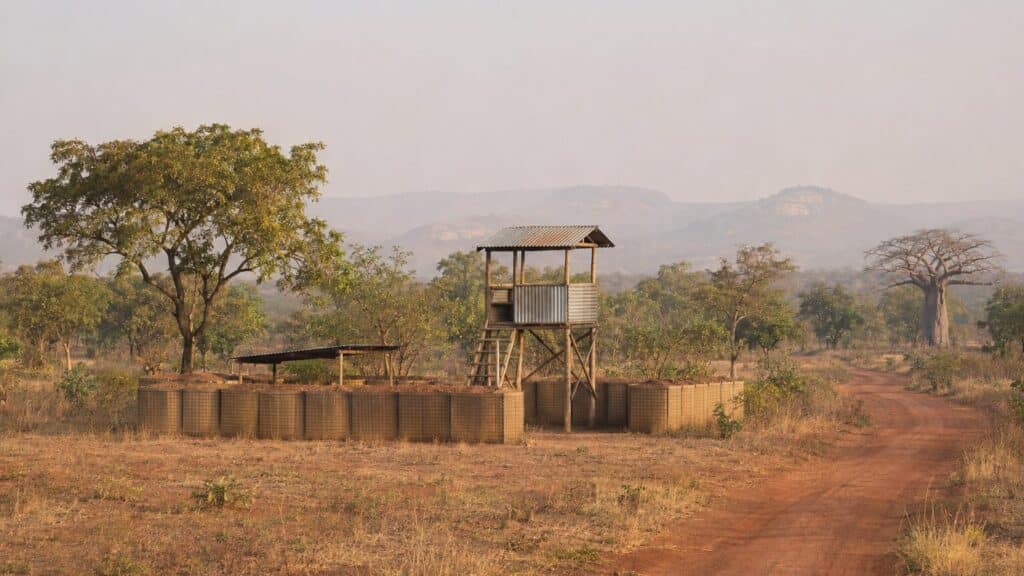
Launched in January 2022, Operation Mirador deploys several thousand troops along the borders with Burkina Faso and Niger. ADF reports around 3,000 soldiers spread across eight forward operating bases and fortified posts around the W-Arly-Pendjari complex, a 27,000 km² group of parks shared by the three countries. The threat there comes mainly from JNIM, an al-Qaeda affiliate, and, further east, from Islamic State Sahel and groups coming from Nigeria. Neighbouring Togo faces the same pressure in the Savanes region. To understand the dynamics of attacks on the Beninese side, see Why are attacks rising in northern Benin?.
The theatre command has changed three times since summer 2024: Colonel Constant Ahiou succeeded Colonel Faïzou Gomina on 31 July 2024, then Colonel André Dokoui Fofo, now army chief of staff, took over in June 2025, before Colonel Claude Raoul Djèhoungo was appointed on 11 November 2026. The new commander, former head of operations of the ECOWAS Standby Force in Abuja from 2022 to 2025, is seconded by Lieutenant Colonel Mathieu Hessou and relies on an air operations cell led by Colonel Joselyto Alapini. According to La Nouvelle Tribune, the chief of the general staff has instructed him to consolidate gains, keep an offensive posture and prioritise intelligence and mobility.
Mirador also has a civil-military side: free medical care (1,700 patients in Atacora), vaccination of 4,000 head of livestock in Matéri commune in May 2025, and civil-military committees bringing together elected officials and traditional chiefs since June 2025. A review workshop on these actions was held in Cotonou on 8 and 9 October 2026.
| Date | Location | Reported toll |
|---|---|---|
| 08/01/2025 | Tri-border point (Karimama, Alibori) | About 28 to 30 soldiers killed, attack claimed by JNIM |
| 17/04/2025 | Tri-border point and Koudou falls (Karimama) | 54 soldiers killed according to the government |
| 05/10/2025 | Ségbana (Alibori, Nigeria border) | Several police officers killed in an attack on a post |
| 04/03/2026 | Kofouno camp (Karimama) | 15 soldiers killed according to the authorities, up to 22 according to other sources |
| 26/05/2026 | Kourou (Burkina Faso border) | Several soldiers killed, two attacks claimed by JNIM |
Source: CGRA-OFPRA report of 25 June 2026 (citing RFI, TV5 Monde, ICG, UN Security Council), AFP via Le360, Journal du Bénin, as of 18 November 2026. Tolls vary between sources.
ACLED figures cited in the same report give the order of magnitude: 398 incidents recorded in Benin between 1 January 2024 and 14 March 2026, 387 of them in the north (60% in Alibori, 29% in Atacora), and 686 deaths. In 2025, 305 deaths were attributed to jihadist groups, 76% more than in 2024: fewer incidents, but deadlier ones.
The Republican Police: internal security and border posts
Created in January 2018 by merging the national police and the gendarmerie, the Republican Police is the single internal security force. It keeps public order in towns and rural areas, secures transport corridors and works with the armed forces on counter-terrorism. It has been led since 7 February 2025 by Brice Kokou Allowanou, promoted to Inspector General of Police (2nd class) on 15 January 2026. At the port of Cotonou, a joint container control unit brings together police, customs and the forestry service.
Its border posts have become targets: Tanongou (Tanguiéta) on 4 June 2025, Kalalé on 10 September 2025 and Ségbana on 5 October 2025. These attacks, further east than the parks, point to pressure from neighbouring Nigeria, where the Mahmuda group and Lakurawa operate. On regional police cooperation, see Is regional police cooperation effective?.
The reshuffle of 4 November 2026: who changed
The Council of Ministers of 4 November 2026 made 98 appointments, including the entire high command. General Fructueux Gbaguidi, chief of the general staff for several years, becomes permanent secretary of the Defence and Security Council, an advisory body provided for by Article 62 of the Constitution. Abou Issa replaces him. Colonel-Major Hermann Avocanh becomes the minister’s adviser for air strategy and new surveillance technologies.
Speaking on 11 November, government spokesperson Wilfried Léandre Houngbédji described the appointments as falling “strictly within the ordinary management and regular administration of the Benin Armed Forces” and unrelated to any “particular situation”. They nonetheless complete the renewal of a team that was in place during the coup attempt, eleven months on.
Note
Official strength figures for the FAB and the Republican Police are not published. The orders of magnitude cited here (3,000 soldiers for Mirador, 5,000 recruits) come from specialist media and should be read as estimates.
Partners and neighbours: no cooperation with Niger or Burkina Faso
France officially provides training, operational advice and intelligence support; according to French sources cited by Le Monde on 10 April 2026, French special forces have been discreetly taking part in some actions in border areas since mid-2025. Nigeria is the most engaged regional partner: strikes on Togbin in December 2025, broader military cooperation, and the reopening on 9 February 2026 of the Tsamiya–Kamba corridor after seven years of closure (ISS, 30 April 2026). On the real effect of such support, see Are foreign special forces decisive?.
With Niger and Burkina Faso, by contrast, security cooperation is suspended. The Malanville–Gaya border has been closed since summer 2023. Romuald Wadagni visited Niamey on 2 June 2026; agreements in principle on security, economic and legal matters were announced on 16 and 22 June, but General Tiani said on 25 July that no reopening date had been set. Niamey accuses Cotonou of hosting foreign military bases, which Benin disputes. The closure also weighs on the Niger-Benin oil pipeline, which Nigerien rebel groups have already targeted. The regional context is covered in ECOWAS-AES talks: what the Dakar meeting changes and in our November 2026 overview.
Watch point
Without intelligence sharing or a right of pursuit with its Sahel neighbours, Benin’s army cannot follow groups that fall back into Burkina Faso or Niger. Their rear bases remain out of reach, which limits the effect of any reinforcement on the Beninese side (see Can national armies hold out alone?).
What this means for organisations operating in Benin
- The north is not a single block. Alibori and Atacora, around the W and Pendjari parks, account for most incidents; eastern Borgou faces pressure from Nigeria. A risk assessment should be carried out commune by commune, using the West Africa security risk map.
- Police posts and roads are exposed. The attacks at Tanongou, Kalalé and Ségbana targeted posts on busy roads. Travel in the north falls under the procedures described in Road convoy security in the Sahel, and the risk of kidnapping for ransom must be built into plans.
- Your counterparts have changed. The entire chain of command, from the general staff to the Mirador theatre, has been new since November 2026. Contacts with local military authorities, access rules for sensitive areas and escort arrangements should be checked again.
What we do not know yet
Three points remain uncertain. The government has not published a new doctrine: the reshuffle may signal continuity as much as a change of posture, and this will be judged over the first months of the new Mirador command. The role of foreign forces on the ground is not officially confirmed. Finally, attack tolls often differ between sources, and the CGRA-OFPRA report itself does not reconcile all its figures.
Operating in this area? See the incidents on your routes in 20 minutes.
Frequently asked questions
Who commands Benin’s army in November 2026?
Lieutenant General Abou Issa has been chief of the general staff of the Benin Armed Forces since the Council of Ministers of 4 November 2026. He replaces General Fructueux Gbaguidi, appointed permanent secretary of the Defence and Security Council. President Romuald Wadagni is supreme commander of the armed forces.
What is Operation Mirador?
It is the military deployment launched in January 2022 to contain the spread of jihadist groups in northern Benin, along the borders with Burkina Faso and Niger. It involves several thousand soldiers and has been commanded since 11 November 2026 by Colonel Claude Raoul Djèhoungo.
What is the difference between the Republican Police and the gendarmerie in Benin?
Benin no longer has a gendarmerie: it merged with the national police in January 2018 to form the Republican Police, the single internal security force, under the minister responsible for the Interior.
Does Benin cooperate with Niger against armed groups?
Not at present. Security cooperation has been suspended since 2023 and the Malanville–Gaya border remains closed. Agreements in principle were announced in June 2026, without a reopening timetable. Benin does cooperate with Nigeria and France.
Sources
- CGRA-OFPRA, “Bénin : situation sécuritaire”, 25 June 2026 (in French)
- ADF, “Holding the line”, February 2026
- Bénin Web TV, military high command reshuffle, 4 November 2026 (in French)
- La Nouvelle Tribune, new Mirador command, 12 November 2026 (in French)
- ISS Africa, Nigeria, Niger, Benin: trade resumes under security threat, 30 April 2026 (in French)