Long perceived as spared from the jihadist threat, Benin has within a few years become the most attacked coastal country in West Africa. Since the first incidents of 2019-2021, the escalation has been continuous: 2025 was the deadliest year for Beninese forces, and 2026 has already seen several major attacks in Alibori and Atacora. Understanding why attacks are rising in northern Benin requires holding together four levels of analysis: the regional strategy of armed groups, the geography of the border triangle, the spillover of the Burkinabe conflict and the specific fragilities of northern Benin. That is the purpose of this analysis, updated in June 2026.
A documented escalation: from harassment to mass attacks
The trajectory of operating methods alone tells the story of the change in scale. The improvised explosive devices and sporadic ambushes of 2021-2023 have given way to coordinated assaults on military positions. On 8 January 2025, the attack on the forward post at “Point Triple” — the tri-border area of Benin, Burkina Faso and Niger — killed 28 soldiers, an attack claimed by Jama’at Nusrat al-Islam wal-Muslimin (JNIM). On 17 April 2025, two positions of Operation Mirador, at the Koudou falls and at Point Triple in W Park, were struck simultaneously: at least 54 soldiers killed according to the official toll — the heaviest in the country’s recent history.
2026 confirms the trend: on 4 March, the attack on the Kofouno camp killed fifteen soldiers; on the night of 25 to 26 May, two positions at Kourou Koualou, on the Burkinabe border, were assaulted by several hundred fighters arriving on motorbikes, a few hours after the inauguration of the new president. The threat is no longer limited to the parks: it is now testing the entire border set-up, as our geopolitical and security overview for June 2026 places in its regional context.
The extension of the Sahelian theatre towards the Gulf of Guinea
The first key to understanding is regional. The violence in northern Benin is part of the southward expansion of Sahelian armed groups, documented notably by the International Crisis Group. JNIM, affiliated with al-Qaeda, is the central actor: its katibas based in eastern Burkina Faso operate along the borders of Benin, Togo and Côte d’Ivoire. The Islamic State in the Sahel (ISGS) remains present on the Nigerien side, but its direct role in Benin remains secondary — the dynamic between the two organisations, analysed in our study of the JNIM-ISGS rivalry, shapes the geography of the regional threat.
For these groups, northern Benin serves three functions: strategic depth (fallback areas in the face of operations in Burkina Faso and Niger), a resource base (recruitment, supplies, war economy) and a lever of pressure on a coastal state perceived as an ally of the Sahelian juntas’ adversaries. The pressure on Benin is no accident: it is one stage in a project of expansion towards the Gulf of Guinea that is also affecting the Savanes region in Togo.
The border triangle: W and Pendjari parks, a cross-border sanctuary
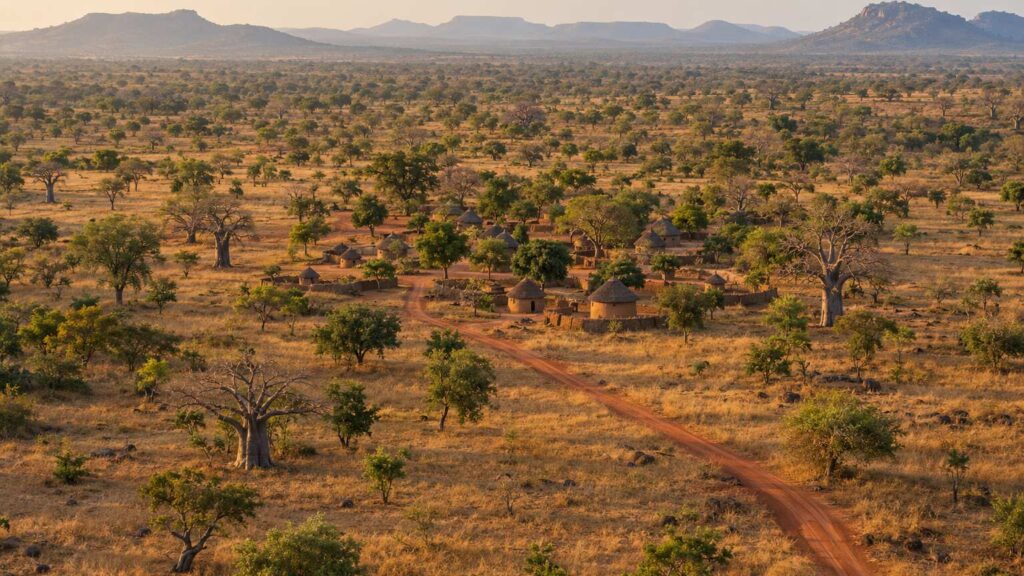
Geography explains the concentration of attacks. The W-Arly-Pendjari complex — one of the largest protected areas in West Africa, straddling Benin, Burkina Faso and Niger — combines everything that serves an armed group: low population density, limited state presence, vegetation cover suited to discreet movement, and borders that are hard to control. The Beninese departments of Alibori and Atacora, which border these parks, account for most incidents — which is why foreign ministries classify the border areas and parks as zones to which travel is formally advised against, as detailed in our map of security risks in West Africa.
These protected areas, long designed for conservation and tourism, now function as operational sanctuaries: “Point Triple”, the scene of the deadliest attacks of 2025, lies precisely at the heart of this cross-border complex.
The spillover of the Burkinabe conflict
The second driver is the internal dynamic in Burkina Faso, whose eastern border region largely escapes state control. The intensification of Burkinabe military operations — and, since 2025-2026, of joint campaigns by the Alliance of Sahel States — produces displacement effects: fighters seeking less contested areas, reconfiguration of logistics routes, and the spread of support networks within cross-border communities. The breakdown of security cooperation between the AES countries and their coastal neighbours complicates intelligence sharing at the very moment the threat demands it: an institutional blind spot that armed groups exploit.
Local factors: more or less receptive ground
Perceived marginalisation and uneven state presence
Sahelian spillover is not enough: there has to be fertile ground. The northern regions have socio-economic indicators below the national average, an uneven state presence and local governance tensions (chieftaincies, administration, protected areas). These fragilities do not mechanically generate violence, but they offer footholds to armed actors who present themselves as arbiters, protectors or providers of a parallel economy.
Land, pastoralism and informal economies
The border areas combine farmer-herder conflicts exacerbated by demographic and climate pressure, land disputes — whose escalation mechanics are analysed in our study of land conflicts that turn violent — and informal economies (smuggling, artisanal gold mining, trafficking) that armed groups know how to tax or “secure”. Elsewhere in the Sahel, jihadism has thrived on exactly these fault lines; the first signs of a similar insertion exist in northern Benin, even if social implantation there remains less deep than in Mali or Burkina Faso.
Benin’s response: a build-up and its limits
Cotonou has not remained passive. Since 2022, Operation Mirador has mobilised some 3,000 troops on the northern border, reinforced by the announced recruitment of 5,000 additional soldiers; the set-up is accompanied by investment in park surveillance, civil-military programmes and increased cooperation with international partners and neighbouring Gulf of Guinea countries. These efforts are slowing the expansion — but the tolls of 2025-2026 show their limits in the face of massive assaults on isolated positions.
The security response also carries its own risks: generalised suspicion towards certain border or pastoral communities can fuel the resentment that armed groups exploit. Field research converges: without linkage to local governance, development and social mediation, military pressure alone displaces the threat more than it reduces it.
What the escalation changes for organisations present in the area
For companies, NGOs and institutions operating in Benin or along the Cotonou-Niamey route, there are three concrete implications:
- Think in terms of routes and radius, not countries. Southern Benin remains at normal or heightened vigilance; the risk is concentrated in Alibori, Atacora and the surroundings of the parks. Monitoring must be carried out at the level of trade corridors and areas of operation.
- Factor in the kidnapping risk. The risk targeting Westerners and exposed staff is established in the north — measures for preventing the risk of kidnapping must be up to date.
- Prepare for sudden shifts. A rapid deterioration remains possible: a realistic and tested evacuation plan is the operational counterpart of any lasting presence in the area.
FAQ — attacks in northern Benin
Who is behind the attacks in northern Benin?
Mainly JNIM (affiliated with al-Qaeda), based in eastern Burkina Faso, which claimed the deadliest attacks of 2025. The Islamic State in the Sahel (ISGS) operates on the Nigerien side but plays a more marginal role in Benin.
What were the deadliest episodes?
8 January 2025 (Point Triple, 28 soldiers killed), 17 April 2025 (Koudou and Point Triple, at least 54 soldiers — the heaviest toll), 4 March 2026 (Kofouno, 15 soldiers) and the Kourou Koualou attack of 25-26 May 2026.
Which areas of Benin are most exposed?
The departments of Alibori and Atacora: border areas with Burkina Faso and Niger, W and Pendjari national parks, and northern communes (Banikoara, Tanguiéta, Natitingou, Kérou, Kouandé). Most foreign ministries formally advise against travel to these areas.
Is southern Benin under threat?
No attack has been recorded there to date and it remains classified at normal to heightened vigilance. The threat does, however, weigh on flows: the Cotonou-Malanville route, vital for regional trade towards Niger, crosses the most exposed areas.
Conclusion
The rise in attacks in northern Benin is neither a geographical inevitability nor a simple mechanical spillover: it is the convergence of a regional expansion strategy by JNIM, a cross-border sanctuary that is hard to control, the effects of the Burkinabe conflict and local fragilities that are real but not irreversible. The 2025-2026 trajectory — more massive and more frequent attacks, closer to the main routes — points to a phase of consolidation that the military response alone will not be enough to reverse. For actors present in the area, the question is no longer whether the risk exists, but how to monitor it at the right level of detail, week after week.